
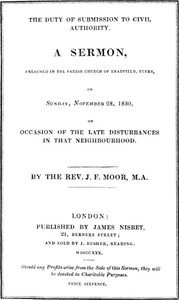
The Duty of Submission to Civil Authority,: A Sermon Preached in the Parish Church of Bradfield, Berkes, on Sunday, November 28, 1830, on Occasion of the Late Disturbances
Written by J. F. (John Frewen) Moor
Chaptra reads alongside you — AI insights, chapter breakdowns and reader discussions for every book. Join free
About this book
Reading guide
Themes, characters and key ideas in The Duty of Submission to Civil Authority,: A Sermon Preached in the Parish Church of Bradfield, Berkes, on Sunday, November 28, 1830, on Occasion of the Late Disturbances, written by Chaptra AI.
- about 1 hours
- intermediate
- didactic
- earnest
- authoritative
J. F. Moor's "The Duty of Submission to Civil Authority" is an early 19th-century sermon that sternly advocates for Christian obedience to governmental powers, preached in the wake of societal disturbances in 1830. Rooted deeply in biblical teachings, particularly from the Apostle Peter, Moor argues that civil authority is divinely instituted, making resistance to it an act against God's order. The sermon defines submission as both an absence of rebellion and active support for lawful governance, while also addressing the nuanced situation where divine and civil laws conflict, instructing believers to obey God but accept consequences peacefully. Ultimately, Moor's work functions as a moral and theological guide, urging Christians to foster peace and righteousness amidst political unrest.
“True Christianity promotes loyalty and obedience rather than rebellion.”
Key themes
- Submission to Civil Authority
- This is the central and overarching theme of the sermon. Moor argues that Christians have a divinely mandated duty to submit to governmental structures and their officeholders. This submission is presented as a core tenet of true Christianity, encompassing both a lack of rebellion and active support for lawful governance. It is framed as an act of obedience to God, who institutes authority.
- Divine Institution of Authority
- Moor's argument for submission is firmly rooted in the theological premise that all civil authority ultimately derives its power from God. This theme underscores that governmental power is not merely a human construct but a divine ordinance, making resistance to the state an act of defiance against God himself. This elevates political obedience to a spiritual imperative.
- Christian Conduct in Tumultuous Times
- The sermon is explicitly preached 'on Occasion of the Late Disturbances,' highlighting its practical aim to guide Christians on how to behave during periods of social and political unrest. It advocates for a specific mode of conduct characterized by peace, loyalty, and non-rebellion, even when faced with grievances or provocations. This theme emphasizes the Christian's role as a peacemaker and an upholder of civic order.
Worth discussing
How does Moor's argument for divine institution of civil authority resonate or conflict with modern democratic principles?
Chapter-by-chapter breakdowns, character arcs and the full thematic analysis come with a free account.
Discussions
No one has started one yet
Questions this book opens up
No discussions yet
Be the first to start a discussion about this book!
Sign up to start the discussionReviews
No reviews yet
Be the first to review this book!