
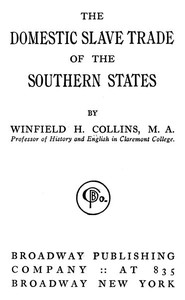
The Domestic Slave Trade of the Southern States
Written by Winfield H. (Winfield Hazlitt) Collins
Chaptra reads alongside you — AI insights, chapter breakdowns and reader discussions for every book. Join free
About this book
Reading guide
Themes, characters and key ideas in The Domestic Slave Trade of the Southern States, written by Chaptra AI.
- about 18 hours
- advanced
- historical
- somber
- analytical
Winfield H. Collins's "The Domestic Slave Trade of the Southern States" is an early 20th-century historical account that meticulously dissects the origins, evolution, and mechanisms of the internal slave trade in the American South. The book traces the trade's roots from its transatlantic beginnings to its domestic consolidation, driven by shifting agricultural economies, particularly the rise of cotton cultivation. Collins explores the intricate interplay of economic imperatives, social structures, and legislative frameworks that facilitated the commodification of human beings. Through extensive research and primary sources, it offers a comprehensive, albeit historically contextualized, portrayal of this dark chapter, emphasizing the economic logic that underpinned the institution.
“The domestic slave trade, often overshadowed by its transatlantic predecessor, was no less vital to the economic machinery of the Southern states.”
Key themes
- Human Commodification
- This is the central theme, exploring how enslaved individuals were systematically stripped of their humanity and reduced to mere property, quantifiable assets to be bought, sold, and leveraged for economic gain. Collins details the mechanisms through which this dehumanization was institutionalized and normalized within the domestic slave trade.
- Economic Determinism
- The book heavily emphasizes the role of economic factors, particularly the rise of cotton cultivation, as the primary engine driving the domestic slave trade. Collins argues that the immense profits to be made from agricultural expansion created an insatiable demand for labor, which in turn dictated the scale, routes, and brutality of the trade.
- Legislative Influence and Complicity
- Collins examines how state and federal laws played a crucial role not only in regulating but also in legitimizing and entrenching the domestic slave trade. The theme explores how legal frameworks, often designed to manage the 'property' of slaveholders, inadvertently solidified the institution and its inherent injustices.
Worth discussing
How does Collins's early 20th-century perspective shape his analysis of the domestic slave trade, and what are its inherent limitations?
Chapter-by-chapter breakdowns, character arcs and the full thematic analysis come with a free account.
Discussions
No one has started one yet
Questions this book opens up
No discussions yet
Be the first to start a discussion about this book!
Sign up to start the discussionReviews
No reviews yet
Be the first to review this book!