
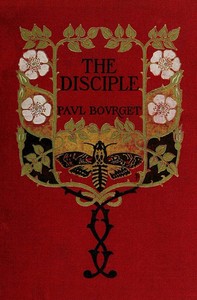
The disciple
Written by Paul Bourget
Chaptra reads alongside you — AI insights, chapter breakdowns and reader discussions for every book. Join free
About this book
Reading guide
Themes, characters and key ideas in The disciple, written by Chaptra AI.
- about 12 hours
- advanced
- philosophical
- dark
- introspective
Paul Bourget's "The Disciple" is a profound philosophical novel from the late 19th century that scrutinizes the moral responsibility of intellectuals and the tangible impact of abstract ideas on individual lives. The narrative centers on Adrien Sixte, a renowned but detached philosopher, whose academic world is shattered when his former disciple, Robert Greslon, is accused of murder. As Sixte delves into the case, he confronts the horrifying possibility that his own amoral scientific doctrines may have inadvertently inspired Greslon's actions, leading to a tragic exploration of guilt, conscience, and the intricate interplay between intellect and passion. The novel ultimately questions the limits of scientific detachment and the enduring necessity of moral frameworks in society.
“"Ideas, like all forces, have their trajectories, and their destructive power is proportionate to their velocity."”
Key themes
- The Responsibility of the Intellectual
- This is the central theme, exploring whether thinkers are accountable for the practical applications or misinterpretations of their abstract ideas. Bourget argues that intellectual pursuits cannot be divorced from moral considerations, and that a purely detached, amoral philosophy can have devastating real-world consequences. Sixte's journey from intellectual arrogance to profound guilt exemplifies this theme.
- The Impact of Ideas on Actions
- This theme investigates how abstract philosophical concepts, particularly those concerning human nature, determinism, and morality, can profoundly influence individual behavior and lead to extreme actions. The novel demonstrates that ideas, once unleashed, can take on a life of their own, often with unintended and tragic consequences, especially when interpreted by impressionable or extreme minds.
- Science vs. Morality/Faith
- Bourget, writing in an era dominated by scientific positivism and naturalism, explores the tension between a purely rational, scientific worldview and traditional moral or spiritual frameworks. The novel critiques the idea that science can provide a complete understanding of humanity without acknowledging the existence or necessity of ethics, conscience, and human compassion. It suggests that a science devoid of morality can lead to nihilism and destruction.
Worth discussing
To what extent are intellectuals morally responsible for the practical applications or misinterpretations of their theories?
Chapter-by-chapter breakdowns, character arcs and the full thematic analysis come with a free account.
Discussions
No one has started one yet
Questions this book opens up
No discussions yet
Be the first to start a discussion about this book!
Sign up to start the discussionReviews
No reviews yet
Be the first to review this book!