
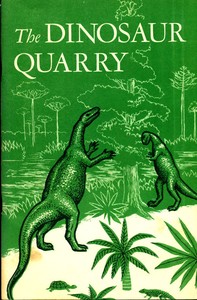
The Dinosaur Quarry. Dinosaur National Monument, Colorado-Utah
Written by John M. (John Maxwell) Good,Gilbert F. Stucker,Theodore Elmer White
Chaptra reads alongside you — AI insights, chapter breakdowns and reader discussions for every book. Join free
About this book
Reading guide
Themes, characters and key ideas in The Dinosaur Quarry. Dinosaur National Monument, Colorado-Utah, written by Chaptra AI.
- about 8 hours
- advanced
- informative
- educational
- scientific
Good, Stucker, and White's "The Dinosaur Quarry" offers a meticulous scientific and historical exploration of Dinosaur National Monument, focusing intently on its renowned fossil quarry. Published in the mid-20th century, the book comprehensively details the discovery, excavation, and scientific significance of the extensive dinosaur remains, particularly 'Apatosaurus' and 'Stegosaurus', found within its bounds. It interweaves paleontological insights into dinosaur biology with a deep dive into the region's unique geology and the intricate processes of fossilization over millions of years. Beyond the scientific data, the authors chronicle the monument's establishment, underscoring its dual role in facilitating ongoing research and educating the public about Earth's prehistoric past.
“The Morrison Formation, a vast expanse of Late Jurassic sediments, holds within its strata an unparalleled record of terrestrial vertebrate life.”
Key themes
- Scientific Discovery and Inquiry
- This theme is central to the book, detailing the entire process of paleontological research from initial discovery and meticulous excavation to the classification and interpretation of fossils. It highlights the scientific method's application in uncovering and understanding prehistoric life, emphasizing observation, data collection, and hypothesis formation.
- Deep Time and Geological Processes
- The book extensively explores the vast timescales involved in Earth's history, focusing on the millions of years that shaped the landscape and preserved the dinosaur fossils. It delves into the geological formations, sediment deposition, and climatic changes of the Jurassic period, illustrating how these processes are fundamental to understanding the fossil record.
- Preservation and Conservation
- This theme highlights the importance of protecting significant natural and scientific sites for future generations. The establishment of Dinosaur National Monument itself is a testament to this, ensuring that the fossil quarry is preserved for ongoing scientific study, public education, and appreciation rather than being exploited or damaged.
Worth discussing
How does the book's mid-20th-century perspective influence its scientific theories, particularly regarding dinosaur biology or extinction, and how might these compare to modern understanding?
Chapter-by-chapter breakdowns, character arcs and the full thematic analysis come with a free account.
Discussions
No one has started one yet
Questions this book opens up
No discussions yet
Be the first to start a discussion about this book!
Sign up to start the discussionReviews
No reviews yet
Be the first to review this book!