
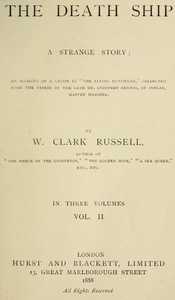
The Death Ship: A Strange Story, Vol. 2 (of 3)
Written by William Clark Russell
Chaptra reads alongside you — AI insights, chapter breakdowns and reader discussions for every book. Join free
About this book
Reading guide
Themes, characters and key ideas in The Death Ship: A Strange Story, Vol. 2 (of 3), written by Chaptra AI.
- about 8 hours
- intermediate
- eerie
- mysterious
- romantic
William Clark Russell's "The Death Ship: A Strange Story, Vol. 2 (of 3)" plunges readers deeper into the harrowing ordeal of Mr. Geoffrey Fenton, a master mariner, and the enigmatic Imogene Dudley, both trapped aboard the fabled Flying Dutchman. As Fenton grapples with the spectral nature of the ship's undead crew and the oppressive atmosphere, his concern for Imogene intensifies, fostering a burgeoning romantic connection amidst their shared terror. This volume focuses on their desperate longing for freedom against the grim reality of Captain Vanderdecken's cursed vessel, exploring profound themes of love, isolation, and the resilience of the human spirit in the face of supernatural horror. It serves as a captivating middle act, deepening the mystery and the characters' emotional journeys.
“"The very air of this ship, I tell you, Mr. Fenton, breathes despair. It clings to one's very soul."”
Key themes
- Hope vs. Despair
- This theme is a driving force, particularly through Imogene's character. She oscillates between moments of profound despair, recognizing the hopelessness of their curse, and fragile glimmers of hope, often sparked by Fenton's presence or a desperate longing for escape. Fenton, while more resolute, also grapples with the immense weight of their predicament, constantly battling to maintain a sense of purpose and protect Imogene from succumbing to utter despair. The very existence of the Death Ship challenges the possibility of hope.
- Isolation and Confinement
- The theme of isolation is central, as Fenton and Imogene are physically trapped on a legendary ghost ship, cut off from all humanity and the known world. This physical confinement leads to profound psychological isolation, where their only human connection is to each other, intensifying their bond but also highlighting their desperate situation. The vast, empty ocean surrounding them reinforces their utter solitude.
- The Supernatural and Reality
- The entire premise of the novel hinges on the collision of the mundane reality of a master mariner with the impossible reality of a cursed ghost ship. This theme explores how characters, particularly Fenton, process and attempt to rationalize (or fail to rationalize) events that defy all natural laws. It questions the boundaries of human perception and belief, forcing characters and readers alike to confront the terrifying possibility that some things exist beyond scientific explanation or human understanding.
Worth discussing
How does the setting of the Flying Dutchman contribute to the novel's themes of isolation and despair?
Chapter-by-chapter breakdowns, character arcs and the full thematic analysis come with a free account.
Discussions
No one has started one yet
Questions this book opens up
No discussions yet
Be the first to start a discussion about this book!
Sign up to start the discussionReviews
No reviews yet
Be the first to review this book!