
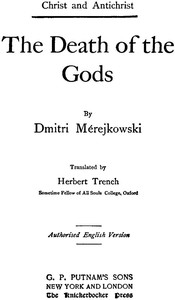
The Death of the Gods: (Christ and Antichrist, 1 of 3)
Written by Dmitry Sergeyevich Merezhkovsky
Chaptra reads alongside you — AI insights, chapter breakdowns and reader discussions for every book. Join free
About this book
Reading guide
Themes, characters and key ideas in The Death of the Gods: (Christ and Antichrist, 1 of 3), written by Chaptra AI.
- about 8 hours
- advanced
- philosophical
- historical
- somber
Dmitry Sergeyevich Merezhkovsky's "The Death of the Gods" is the first installment in his "Christ and Antichrist" trilogy, a historical novel centered on the life of Roman Emperor Julian the Apostate in the 4th century A.D. The narrative vividly portrays Julian's ambitious endeavor to revive ancient Paganism amidst the burgeoning influence of Christianity within the Roman Empire. It delves into the profound philosophical and spiritual clashes between these two worldviews, exploring humanity's perennial search for meaning and purpose during a period of immense societal transformation. The story opens with Marcus Scuda's plot to free Julian and Gallus, setting the stage for Julian's complex ascent and his epic struggle against the prevailing historical currents. This richly detailed work establishes a dramatic tone, blending historical depth with intense personal and ideological conflicts.
“"The gods die, not when men cease to believe in them, but when men cease to live for them."”
Key themes
- Paganism vs. Christianity
- This is the central thematic conflict of the novel, exploring the ideological, philosophical, and cultural clash between the ancient polytheistic religions and the burgeoning monotheistic faith of Christianity in the 4th century Roman Empire. Merezhkovsky delves into the aesthetic beauty, philosophical depth, and spiritual freedom associated with Paganism, contrasting it with the perceived asceticism, dogmatism, and political power of early Christianity. The novel examines how these two worldviews compete for the hearts and minds of the people and the soul of the empire.
- The Search for Meaning and Truth
- Julian's personal quest is fundamentally a search for truth and meaning in a world undergoing profound transformation. Disillusioned with the Christianity of his oppressors and drawn to the intellectual richness of classical thought, he seeks a system of belief that can provide both spiritual fulfillment and a coherent understanding of the universe. This theme explores the intellectual and emotional struggle to find bedrock principles in a time of ideological upheaval.
- Power and Ambition
- Beyond the spiritual conflict, the novel is deeply concerned with the mechanics of power, the corrupting influence of ambition, and the strategies employed to gain and maintain imperial control. From Marcus Scuda's initial machinations to Constantius's paranoid rule and Julian's eventual ascension, the narrative dissects the political landscape of the Roman Empire, revealing how personal desires intersect with grand historical movements.
Worth discussing
How does Merezhkovsky portray Julian the Apostate, and does he succeed in making him a sympathetic or admirable figure despite his opposition to Christianity?
Chapter-by-chapter breakdowns, character arcs and the full thematic analysis come with a free account.
Discussions
No one has started one yet
Questions this book opens up
No discussions yet
Be the first to start a discussion about this book!
Sign up to start the discussionReviews
No reviews yet
Be the first to review this book!