
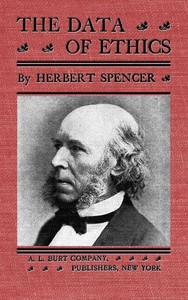
The Data of Ethics
Written by Herbert Spencer
Chaptra reads alongside you — AI insights, chapter breakdowns and reader discussions for every book. Join free
About this book
Reading guide
Themes, characters and key ideas in The Data of Ethics, written by Chaptra AI.
- about 15 hours
- advanced
- philosophical
- analytical
- didactic
Herbert Spencer's "The Data of Ethics," a foundational text within his "System of Synthetic Philosophy," endeavors to establish morality on a scientific, evolutionary basis, departing from traditional supernatural justifications. Published in the late 19th century, this work systematically explores the principles underlying human conduct, tracing its development from rudimentary biological impulses to complex societal ethics. Spencer argues for a secular understanding of morality, necessitated by the perceived decline of conventional ethical systems, proposing that ethical standards evolve in tandem with human society. The book's preface outlines Spencer's ambition to provide an empirically-grounded framework for ethics, examining conduct as a dynamic whole deeply intertwined with individual actions and their broader societal consequences. It posits that a robust ethical system must be understood through the lens of evolutionary progress and adaptation.
“Ethics, no less than physics, must find its data in the observable world, not in the dictates of revelation.”
Key themes
- Scientific Ethics
- The central ambition of the book is to establish ethics on a purely scientific and empirical foundation, moving away from theological or metaphysical justifications. Spencer argues that moral principles can be derived from the observation of natural phenomena, particularly the evolution of conduct.
- Evolution of Morality and Conduct
- Spencer's work is deeply embedded in evolutionary thought, positing that moral standards and conduct are not static but evolve over time, becoming more complex and adaptive as societies develop. He traces this evolution from simple biological impulses to intricate human social ethics.
- Secularism and Naturalism
- The book explicitly advocates for a secular approach to ethics, rejecting supernatural or divinely revealed moral codes. Spencer emphasizes the need for an empirically-based understanding of ethics that can stand independently of religious dogma, a crucial move in late 19th-century thought.
Worth discussing
To what extent can ethics truly be derived from scientific observation and evolutionary principles, as Spencer suggests?
Chapter-by-chapter breakdowns, character arcs and the full thematic analysis come with a free account.
Discussions
No one has started one yet
Questions this book opens up
No discussions yet
Be the first to start a discussion about this book!
Sign up to start the discussionReviews
No reviews yet
Be the first to review this book!