
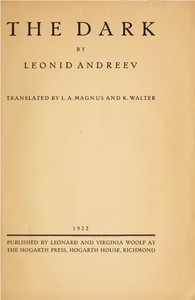
The dark
Written by Leonid Andreyev
Chaptra reads alongside you — AI insights, chapter breakdowns and reader discussions for every book. Join free
About this book
Read it with a club
Chaptra's fiction clubs — small groups reading the same books and talking as they go.


CraxMe Readers Book Club
Fiction
- 385 members
- 227 discussions
- Started December 2025
Welcome to the Readers Book Club. This is an informal group for like-minded people, where you can discuss books, share and recommend, track your reading progress, and lots more. Discuss Books — all about books. Discuss a particular book or genre, share your favourite quotes. Book Reviews — loved a book and highly recommend it? Or was it just average? Share your review and discuss with fellow readers. (May contain spoilers.) Group Reads — what is a book club without a group read! Buddy Reads — planning to read a book and looking for someone to read it with? Post in the Buddy Read request thread, find a reading buddy, and start discussing.
Read The dark alongside people who are reading it too.
Also here: Doorstops, First Lines Club
Chaptra Prime — paid clubs, every club feature, and unlimited reading support, for $5 a month or $60 once.
See PrimeReading guide
Themes, characters and key ideas in The dark, written by Chaptra AI.
- about 8 hours
- advanced
- dark
- brooding
- psychological
Leonid Andreyev's "The Dark" plunges into the psychological turmoil of Alexis, a young radical on the brink of a terrorist act in early 20th-century Russia. Exhausted and hunted by the police, Alexis seeks refuge in a brothel, an unfamiliar world that forces him to confront his deeply held ideals and the stark realities of human suffering. His encounter with Liuba, a young prostitute, sparks a profound moral crisis, challenging his revolutionary fervor with an unexpected surge of compassion and a desperate search for genuine human connection. The novel is a brooding exploration of existential despair, the ethics of political violence, and the enduring human need for understanding amidst a world steeped in darkness.
“The darkness within me is as vast as the darkness of the world I seek to change.”
Key themes
- Moral Ambiguity and the Ethics of Revolution
- The novel deeply explores the moral complexities inherent in revolutionary acts, particularly the justification of violence for an abstract 'greater good.' It questions whether righteous ends can sanctify unrighteous means, and how individual conscience grapples with collective ideological demands.
- Existential Despair and the Search for Meaning
- Andreyev delves into the profound sense of meaninglessness and despair that can arise from a world perceived as inherently dark and unjust. Alexis's revolutionary fervor can be seen as an attempt to impose meaning on an indifferent universe, while his breakdown reveals the fragility of such externally imposed purpose.
- Human Connection and Compassion
- Despite the prevailing darkness, the novel highlights the enduring human need for connection and the transformative power of compassion. Alexis's unexpected empathy for Liuba challenges his ideological detachment, suggesting that genuine human understanding can offer a different path to meaning or redemption than political action.
Worth discussing
How does Andreyev use the setting of the brothel to explore Alexis's moral and existential crisis?
Chapter-by-chapter breakdowns, character arcs and the full thematic analysis come with a free account.
Discussions
No one has started one yet
Questions this book opens up
No discussions yet
Be the first to start a discussion about this book!
Sign up to start the discussionReviews
No reviews yet
Be the first to review this book!