
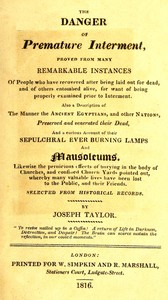
The danger of premature interment : $b Proved from many remarkable instances of people who have recovered after being laid out for dead, and of others entombed alive, for want of being properly examined prior to interment
Written by Joseph Taylor
Chaptra reads alongside you — AI insights, chapter breakdowns and reader discussions for every book. Join free
About this book
Reading guide
Themes, characters and key ideas in The danger of premature interment : $b Proved from many remarkable instances of people who have recovered after being laid out for dead, and of others entombed alive, for want of being properly examined prior to interment, written by Chaptra AI.
- about 10 hours
- advanced
- grim
- cautionary
- somber
Joseph Taylor's "The Danger of Premature Interment" is an early 19th-century medical treatise that meticulously addresses the terrifying phenomenon of being buried alive. Through a compilation of historical anecdotes and case studies, Taylor argues for the critical importance of rigorous examination to confirm death before interment. The book aims to instill a profound sense of caution and responsibility in medical professionals and the public, emphasizing the ethical imperative to prevent such irreversible tragedies. Taylor's grim opening sets a serious tone, reflecting on the psychological horror of premature burial and advocating for a more deliberate approach to certifying death, thereby laying a foundational argument for improved medical and social practices surrounding mortality.
“"Of all the physical evils to which humanity is subject, that of premature interment is, perhaps, the most appalling."”
Key themes
- The Fragility of Life and the Ambiguity of Death
- This is the central theme, exploring how difficult it was in the early 19th century to definitively distinguish between a deep coma, trance, or other suspended animation and actual death. Taylor's numerous anecdotes highlight the precariousness of life and the fine, often imperceptible, line separating it from ultimate cessation, challenging contemporary understandings of mortality.
- Medical Responsibility and Ethical Practice
- Taylor vehemently argues for a heightened sense of responsibility among medical practitioners and those attending to the deceased. He critiques the hasty pronouncements of death and advocates for thorough, scientifically informed examinations, laying an early foundation for modern medical ethics regarding death certification and patient care.
- The Fear of Premature Burial
- This theme explores the profound psychological terror associated with being buried alive, a primal fear that Taylor expertly exploits to drive his argument. He taps into universal anxieties about helplessness, isolation, and a horrifying end, making the book not just an academic text but a deeply disturbing experience for the reader.
Worth discussing
How did the limited medical knowledge of the early 19th century contribute to the fear of premature interment, and what advancements have mitigated this fear today?
Chapter-by-chapter breakdowns, character arcs and the full thematic analysis come with a free account.
Discussions
No one has started one yet
Questions this book opens up
No discussions yet
Be the first to start a discussion about this book!
Sign up to start the discussionReviews
No reviews yet
Be the first to review this book!