
About this book
Reading guide
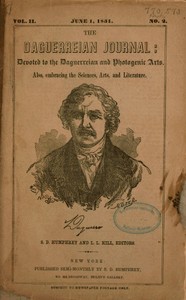
Themes, characters and key ideas in The Daguerreian Journal, Vol. II, No. 2, June 1, 1851, written by Chaptra AI.
- about 10 hours
- advanced
- informative
- scientific
- exploratory
The Daguerreian Journal, Vol. II, No. 2, June 1, 1851, is a pivotal mid-19th-century scientific publication dedicated to the burgeoning fields of daguerreotypy and photogenic arts. This issue serves as a vital record of early photographic and scientific exploration, presenting cutting-edge research, experimental findings, and technological updates. It features a detailed article by Robert Hunt on the light sensitivity of iodized silver plates and the interaction of metals in photographic processes. The journal collectively aims to inform and educate its readership on contemporary advancements, thereby fostering the rapid evolution of photography and related sciences.
“Our ongoing experiments reveal the profound sensitivity of iodized silver plates, extending beyond mere exposure to light, into the subtle interactions of darkness and metallic proximity.”
Key themes
- Scientific Inquiry and Experimentation
- This journal is a direct testament to the rigorous application of the scientific method in the mid-19th century. It emphasizes the importance of systematic observation, hypothesis testing, and detailed reporting of experimental results to advance understanding in nascent fields like photography. Robert Hunt's article serves as a prime example of this theme, detailing specific experiments on light-sensitive materials and their chemical interactions.
- Technological Advancement and Innovation
- The journal actively tracks and promotes the latest technological innovations, not only within photography but also in related fields like telegraphy. It showcases the era's fascination with progress and the rapid pace at which new inventions were transforming society. The focus on improved materials and new techniques underscores the continuous drive for practical application and refinement.
- Dissemination of Knowledge
- As a scientific publication, a core function of the journal is the systematic sharing of research findings, experimental methods, and technical knowledge among a specialized community. This theme emphasizes the collaborative nature of scientific progress and the vital role of communication in fostering innovation and education.
Worth discussing
How did scientific journals like 'The Daguerreian Journal' contribute to the rapid development and standardization of new technologies in the 19th century?
Chapter-by-chapter breakdowns, character arcs and the full thematic analysis come with a free account.
Discussions
No one has started one yet
Questions this book opens up
No discussions yet
Be the first to start a discussion about this book!
Sign up to start the discussionReviews
No reviews yet
Be the first to review this book!