
About this book
Reading guide
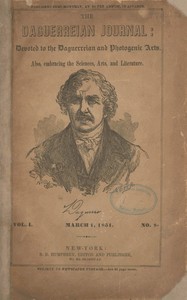
Themes, characters and key ideas in The Daguerreian Journal, Vol. I, No. 8, March 1, 1851, written by Chaptra AI.
- about 3 hours
- advanced
- informative
- technical
- historical
This specific issue of "The Daguerreian Journal," published on March 1, 1851, serves as a vital historical document for understanding the scientific and artistic advancements in mid-19th-century photography. Edited by 'Various,' it is a scientific publication dedicated to the Daguerreian and Photogenic arts, offering practitioners and enthusiasts insights into the evolving techniques, chemistry, and artistic applications of early photography. The core of this particular volume centers on a detailed exposition of methods for etching Daguerreotype plates, with a significant focus on W. R. Grove's innovative process. This method, leveraging electrical currents in conjunction with Daguerreotype plates, promised superior detail and precision, highlighting the journal's commitment to disseminating cutting-edge chemical experimentation and its practical applications in photography.
“The opening of this issue presents a detailed exploration of methods for etching Daguerreotype plates, grounded in chemical experimentation.”
Key themes
- Scientific Innovation and Progress
- This theme is central, highlighted by the introduction of W. R. Grove's novel electrochemical etching method. The journal serves as a platform for disseminating new scientific discoveries and techniques, demonstrating the continuous drive for improvement and efficiency in the nascent field of photography. It underscores the belief that scientific inquiry can lead to practical advancements.
- Intersection of Science and Art
- The journal explicitly explores how scientific principles, particularly chemistry and electrochemistry, are directly applied to enhance the artistic output of Daguerreotypes. It bridges the gap between empirical scientific experimentation and the aesthetic goals of early photographers, positioning photography as a discipline that inherently requires both scientific understanding and artistic vision.
- Empirical Experimentation and Practical Application
- The journal's content is deeply rooted in empirical observation and practical testing. It details experimental procedures, expected outcomes, and the rationale behind specific chemical and physical manipulations. The emphasis is on providing actionable knowledge that practitioners can use to achieve tangible improvements in their work, highlighting the hands-on, problem-solving nature of 19th-century science.
Worth discussing
How does this journal issue reflect the intersection of scientific inquiry and artistic practice in the mid-19th century?
Chapter-by-chapter breakdowns, character arcs and the full thematic analysis come with a free account.
Discussions
No one has started one yet
Questions this book opens up
No discussions yet
Be the first to start a discussion about this book!
Sign up to start the discussionReviews
No reviews yet
Be the first to review this book!