
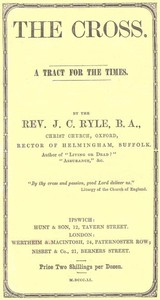
The Cross: A Tract for the Times
Written by J. C. (John Charles) Ryle
Chaptra reads alongside you — AI insights, chapter breakdowns and reader discussions for every book. Join free
About this book
Reading guide
Themes, characters and key ideas in The Cross: A Tract for the Times, written by Chaptra AI.
- about 2 hours
- intermediate
- serious
- didactic
- earnest
J. C. Ryle's "The Cross: A Tract for the Times" is a powerful 19th-century evangelical pamphlet asserting the absolute centrality of Christ's crucifixion to Christian faith and salvation. Ryle passionately argues that true belief hinges entirely on understanding and accepting the redemptive work accomplished on the cross, rejecting any reliance on personal merit, religious practices, or national identity. Drawing heavily on the Apostle Paul's example, Ryle exhorts readers to glory solely in the cross, seeing it as the ultimate demonstration of God's love and the complete answer to sin. The tract serves as both a theological exposition and a fervent call to a faith that yields assurance, hope, and motivation for holy living.
“I want to examine what the Apostle Paul means when he says, 'God forbid that I should glory, save in the cross of our Lord Jesus Christ!'”
Key themes
- The Centrality of the Cross
- This is the overarching theme, asserting that the cross of Jesus Christ is not merely one aspect of Christianity but its absolute core and the sole foundation for salvation. Ryle argues that true faith must begin and end with a deep understanding and acceptance of Christ's atoning sacrifice.
- Salvation by Grace Through Faith
- Ryle strongly advocates for the Protestant doctrine of *sola fide* (faith alone) and *sola gratia* (grace alone), emphasizing that salvation is a free gift of God, received through faith in Christ's finished work on the cross, rather than through human effort, merit, or ritual.
- The Seriousness of Sin and the Completeness of Salvation
- Ryle presents the cross as the ultimate revelation of both the gravity of human sin (requiring such a costly sacrifice) and the sufficiency of God's provision for it. He argues that only by understanding the depth of sin can one truly appreciate the completeness of the salvation offered through Christ.
Worth discussing
What does Ryle mean by 'glorying in the cross,' and how does this differ from merely acknowledging it?
Chapter-by-chapter breakdowns, character arcs and the full thematic analysis come with a free account.
Discussions
No one has started one yet
Questions this book opens up
No discussions yet
Be the first to start a discussion about this book!
Sign up to start the discussionReviews
No reviews yet
Be the first to review this book!