
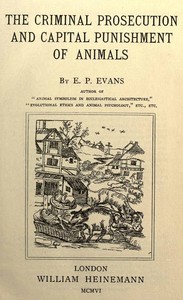
The Criminal Prosecution and Capital Punishment of Animals
Written by E. P. (Edward Payson) Evans
Chaptra reads alongside you — AI insights, chapter breakdowns and reader discussions for every book. Join free
About this book
Reading guide
Themes, characters and key ideas in The Criminal Prosecution and Capital Punishment of Animals, written by Chaptra AI.
- about 8 hours
- advanced
- historical
- absurd
- scholarly
E. P. Evans's "The Criminal Prosecution and Capital Punishment of Animals" is a meticulously researched historical account exploring the bizarre legal phenomenon of prosecuting and punishing animals in medieval and early modern Europe. The book delves into a period where animals, from pigs and cows to rats and insects, were formally tried in courts, complete with lawyers, witnesses, and even capital sentences. Evans masterfully dissects the motivations behind these trials, tracing their roots in religious belief, societal superstition, and the nascent stages of legal thought. Through a wealth of fascinating anecdotes and legal precedents, the work illuminates the peculiar intersection of human law, animal behavior, and theological interpretations, offering a unique window into the cultural psyche of past eras.
“The animal, when arraigned before a court, was treated in every respect as if it were a human criminal.”
Key themes
- Human Perception of Animals
- This theme explores how humans in medieval and early modern Europe viewed animals not merely as property or resources, but as entities capable of moral wrongdoing and legal accountability. Evans demonstrates that animals were often perceived as agents with a degree of free will, or at least subject to divine judgment, reflecting a worldview where the lines between human and animal, and between natural and supernatural, were far more blurred than today.
- The Evolution of Legal Thought and Justice
- Evans meticulously traces how legal systems grappled with the concept of justice when applied to non-human entities. The book illustrates the nascent stages of legal reasoning, where the desire for order and accountability often superseded rational considerations of intent or capacity. It showcases the slow, often contradictory, development of legal principles, moving from broad, all-encompassing applications to more nuanced understandings of culpability and jurisdiction.
- Superstition and Religious Influence
- The book reveals the profound impact of superstition, folk beliefs, and religious doctrine on legal practices. Many animal trials, especially those involving vermin, were deeply rooted in theological interpretations of pestilence as divine punishment or the belief in demonic influence. The legal system often served as a means to exorcise perceived evil or to appease a higher power, blurring the lines between legal punishment and religious ritual.
Worth discussing
How do the animal trials discussed by Evans reflect the broader societal, religious, and legal beliefs of medieval and early modern Europe?
Chapter-by-chapter breakdowns, character arcs and the full thematic analysis come with a free account.
Discussions
No one has started one yet
Questions this book opens up
No discussions yet
Be the first to start a discussion about this book!
Sign up to start the discussionReviews
No reviews yet
Be the first to review this book!