
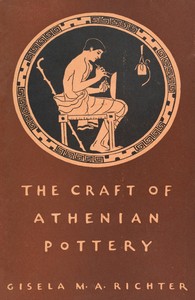
The Craft of Athenian Pottery: An Investigation of the Technique of Black-Figured and Red-Figured Athenian Vases
Written by Gisela M. A. (Gisela Marie Augusta) Richter
Chaptra reads alongside you — AI insights, chapter breakdowns and reader discussions for every book. Join free
About this book
Reading guide
Themes, characters and key ideas in The Craft of Athenian Pottery: An Investigation of the Technique of Black-Figured and Red-Figured Athenian Vases, written by Chaptra AI.
- about 12 hours
- advanced
- Scholarly
- Informative
- Analytical
Gisela M. A. Richter's "The Craft of Athenian Pottery" is a seminal scholarly work from the early 20th century, meticulously investigating the technical processes behind ancient Greek black-figure and red-figure Athenian vases. Richter innovatively combines hands-on pottery training and practical insights into modern clay working with rigorous archaeological findings and classical literary references. Her primary motivation is to leverage the consistent properties of clay across millennia to shed light on ancient methods, thereby challenging and revising established theories on Athenian ceramic craftsmanship. The book systematically details the stages of pottery creation, from clay preparation and wheel work to firing and decoration, offering a deeper, more informed understanding of these celebrated artifacts.
“The consistent properties of clay over time provide a unique bridge between modern practice and ancient technique, allowing us to reconstruct the past with an unprecedented degree of certainty.”
Key themes
- Reconstruction of Ancient Technology
- This is the core theme, as Richter explicitly aims to reverse-engineer the processes used by ancient Athenian potters. She demonstrates how a deep understanding of modern pottery techniques, combined with archaeological evidence, allows for the accurate reconstruction of historical methods for black-figure and red-figure vases. The book meticulously details each step, from clay preparation to firing, to demystify ancient craftsmanship.
- The Interplay of Art and Craftsmanship
- Richter's work emphasizes that the artistic beauty and iconic status of Athenian vases are inseparable from the technical skill and precise craftsmanship involved in their creation. She moves beyond purely aesthetic analysis to demonstrate how the mastery of materials and techniques was fundamental to achieving the desired artistic effects, blurring the lines between 'art' and 'craft'.
- Empirical and Interdisciplinary Research
- A central, meta-theme of the book is Richter's pioneering methodology itself. She argues for the necessity of an empirical, hands-on approach combined with traditional archaeological and textual scholarship. This interdisciplinary method, integrating practical experience (modern pottery), historical evidence (archaeological finds), and textual sources (classical literature), is presented as the most robust way to understand complex historical processes.
Worth discussing
How does Richter's interdisciplinary methodology (combining practical pottery, archaeology, and textual analysis) enhance our understanding of ancient crafts compared to a single-discipline approach?
Chapter-by-chapter breakdowns, character arcs and the full thematic analysis come with a free account.
Discussions
No one has started one yet
Questions this book opens up
No discussions yet
Be the first to start a discussion about this book!
Sign up to start the discussionReviews
No reviews yet
Be the first to review this book!