
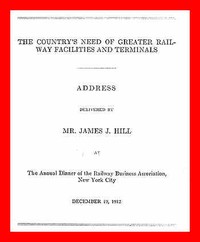
The Country's Need of Greater Railway Facilities and Terminals: Address Delivered at the Annual Dinner of the Railway Business Association, New York City, December 19, 1912
Written by James J. (James Jerome) Hill
Chaptra reads alongside you — AI insights, chapter breakdowns and reader discussions for every book. Join free
About this book
Reading guide
Themes, characters and key ideas in The Country's Need of Greater Railway Facilities and Terminals: Address Delivered at the Annual Dinner of the Railway Business Association, New York City, December 19, 1912, written by Chaptra AI.
- about 1 hours
- advanced
- Urgent
- Analytical
- Prescient
James J. Hill's 1912 address, "The Country's Need of Greater Railway Facilities and Terminals," serves as an urgent economic and scientific examination of the American transportation system. Hill argues that the nation's railway infrastructure, particularly its terminal facilities, is critically inadequate to support the rapidly expanding demands of commerce and trade. He highlights the detrimental economic consequences of railway congestion, attributing it to a disconnect between growing freight tonnage and stagnant railway capacity, compounded by operational costs and regulatory hurdles. Hill's discourse is a prescient call for substantial capital investment and a collaborative effort between the public and private sectors to modernize the railway network, asserting its vital role in ensuring national economic prosperity.
“The growth of freight tonnage far outpaces the railway's capacity to handle it efficiently.”
Key themes
- Infrastructure and Economic Prosperity
- This is the core theme, arguing that a nation's economic health is directly dependent on the efficiency and capacity of its transportation infrastructure, particularly railways. Hill posits that inadequate terminals directly throttle commerce and trade, leading to national economic stagnation.
- Capital Investment and National Development
- Hill stresses the absolute necessity of significant capital investment to upgrade and expand railway facilities. He argues that without this financial commitment, the nation cannot progress economically, and existing infrastructure will prove insufficient for future growth.
- Regulatory Impact and Industrial Viability
- The address implicitly and explicitly explores the tension between government regulation and the operational viability and investment capacity of private industry. Hill suggests that overly restrictive or unbalanced regulation can hinder necessary investment and expansion, thereby undermining the very public interest it aims to serve.
Worth discussing
To what extent do Hill's arguments about infrastructure and economic prosperity remain relevant in today's global economy?
Chapter-by-chapter breakdowns, character arcs and the full thematic analysis come with a free account.
Discussions
No one has started one yet
Questions this book opens up
No discussions yet
Be the first to start a discussion about this book!
Sign up to start the discussionReviews
No reviews yet
Be the first to review this book!