
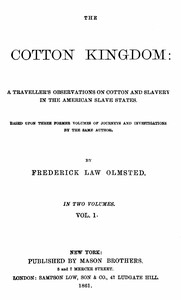
The Cotton Kingdom, volume 1 (of 2) : $b A traveller's observations on cotton and slavery in the American Slave States
Written by Frederick Law Olmsted
Chaptra reads alongside you — AI insights, chapter breakdowns and reader discussions for every book. Join free
About this book
Reading guide
Themes, characters and key ideas in The Cotton Kingdom, volume 1 (of 2) : $b A traveller's observations on cotton and slavery in the American Slave States, written by Chaptra AI.
- about 15 hours
- advanced
- observational
- critical
- analytical
Frederick Law Olmsted's 'The Cotton Kingdom, volume 1' is a seminal work of investigative journalism, compiling his observations from extensive travels through the American South in the 1850s. As a Northern journalist and landscape architect, Olmsted meticulously documented the economic, social, and cultural realities of the slave states, focusing on the pervasive influence of cotton cultivation and the institution of slavery. He presents a detailed, often damning, account of slavery's inefficiency, its detrimental impact on both enslaved people and white society, and its role in stunting the South's overall development. The book serves as a powerful, empirically-driven argument against slavery, offering a stark contrast to prevailing romanticized notions of the antebellum South.
“Slavery drives free labor out of the community; it makes every kind of labor disreputable, and every free man who is not rich, a serf.”
Key themes
- The Economic Inefficiency of Slavery
- Olmsted's central and most rigorously argued theme is that slavery, despite its apparent profitability for a few planters, was an inherently inefficient and economically detrimental system for the South as a whole. He meticulously compares slave labor to free labor, demonstrating how slavery led to poor agricultural practices, lack of innovation, exhausted soil, and an overall lower standard of living compared to the Northern states. He argues that enslaved people, lacking incentive, were less productive than free laborers, and the system itself stifled diversified economic development.
- The Social and Moral Degradation of Slavery
- Beyond economics, Olmsted explores how slavery corrupted the social fabric and moral character of the South. He argues that the institution fostered a culture of violence, indolence among slaveholders (who relied on forced labor), and a lack of respect for manual work among whites. For enslaved people, it meant dehumanization, constant fear, and the destruction of family units. The existence of slavery created rigid social hierarchies and prevented the emergence of a thriving middle class or an educated populace among non-slaveholding whites.
- The Landscape and Environment as a Reflection of Society
- Olmsted, a landscape architect, pays close attention to the physical environment, using it as a direct indicator of the social and economic health of a region. He frequently contrasts the well-maintained, diverse landscapes of the North with the often-exhausted, poorly managed, and monocultural landscapes of the South. The unkempt appearance of farms, the prevalence of erosion, and the lack of infrastructural development are presented as direct consequences of the slave system's short-sightedness and inefficiency.
Worth discussing
How does Olmsted's economic critique of slavery complement or diverge from moral arguments against it?
Chapter-by-chapter breakdowns, character arcs and the full thematic analysis come with a free account.
Discussions
No one has started one yet
Questions this book opens up
No discussions yet
Be the first to start a discussion about this book!
Sign up to start the discussionReviews
No reviews yet
Be the first to review this book!