
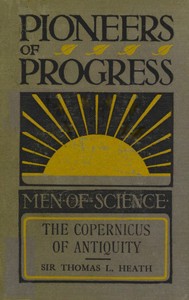
The Copernicus of Antiquity (Aristarchus of Samos)
Written by Thomas Little Heath
Chaptra reads alongside you — AI insights, chapter breakdowns and reader discussions for every book. Join free
About this book
Read it with a club
Small groups reading the same books and talking as they go.


News
- 4 members
- 1,813 discussions
- Active Sep 11
Read The Copernicus of Antiquity (Aristarchus of Samos) alongside people who are reading it too.
Also here: News Bulletin, Just Joking....
Chaptra Prime — paid clubs, every club feature, and unlimited reading support, for $5 a month or $60 once.
See PrimeReading guide
Themes, characters and key ideas in The Copernicus of Antiquity (Aristarchus of Samos), written by Chaptra AI.
- about 10 hours
- advanced
- Informative
- Scholarly
- Analytical
Sir Thomas Little Heath's "The Copernicus of Antiquity (Aristarchus of Samos)" is a seminal early 20th-century scientific history that meticulously details the astronomical contributions of Aristarchus of Samos. Heath argues for Aristarchus's groundbreaking heliocentric theory, positioning it as a revolutionary precursor to Copernicus's later work. The book provides a rich historical context of early Greek astronomy, tracing the intellectual lineage from figures like Thales and Anaximander to Aristarchus. By emphasizing Aristarchus's observational skills and philosophical clarity, Heath underscores the profound intellectual achievements of ancient Greek science. Ultimately, the work re-establishes Aristarchus's significance in the history of scientific thought, highlighting how his ideas laid crucial groundwork for future astronomical understanding.
“Aristarchus's vision, though centuries ahead of its time, stands as a testament to the profound intellectual courage of ancient Greek thought.”
Key themes
- Scientific Progress and Paradigm Shifts
- Heath meticulously illustrates that scientific progress is not always linear. Aristarchus's heliocentric model was a radical paradigm shift that was largely ignored, only to be rediscovered and accepted centuries later. The book explores how new ideas challenge existing frameworks and the societal and intellectual resistance they often face.
- The Nature of Scientific Discovery and Intellectual Courage
- The book celebrates the intellectual bravery required to formulate and propose a theory that contradicts prevailing wisdom and common-sense perception. Heath highlights Aristarchus's ability to combine observational data with sophisticated mathematical reasoning to arrive at a revolutionary conclusion.
- Historical Neglect and Rediscovery
- A central tenet of Heath's work is the rectification of a historical oversight. He brings Aristarchus's contributions out of obscurity, demonstrating how a pivotal figure and his ideas were largely forgotten or downplayed for centuries. This theme explores the mechanisms of historical memory and the process of intellectual rediscovery.
Worth discussing
How does Heath's work challenge or confirm your previous understanding of the origins of heliocentrism?
Chapter-by-chapter breakdowns, character arcs and the full thematic analysis come with a free account.
Discussions
No one has started one yet
Questions this book opens up
No discussions yet
Be the first to start a discussion about this book!
Sign up to start the discussionReviews
No reviews yet
Be the first to review this book!