
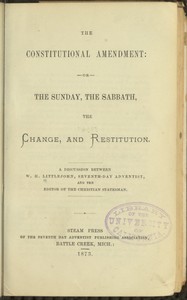
The Constitutional Amendment: or, The Sunday, the Sabbath, the Change, and Restitution: A discussion between W. H. Littlejohn, Seventh-day Adventist, and the editor of the Christian Statesman
Written by Wolcott H. Littlejohn
Chaptra reads alongside you — AI insights, chapter breakdowns and reader discussions for every book. Join free
About this book
Reading guide
Themes, characters and key ideas in The Constitutional Amendment: or, The Sunday, the Sabbath, the Change, and Restitution: A discussion between W. H. Littlejohn, Seventh-day Adventist, and the editor of the Christian Statesman, written by Chaptra AI.
- about 8 hours
- advanced
- serious
- argumentative
- polemical
This book documents a pivotal late 19th-century religious debate between W. H. Littlejohn, a Seventh-day Adventist, and the editor of the Christian Statesman, focusing on the proposed U.S. Constitutional amendment to recognize Sunday as the national day of rest. Littlejohn argues vehemently for the biblical seventh-day Sabbath and warns against the infringement on religious liberty that state-enforced Sunday observance would entail. The discussion explores deeply held theological interpretations of the Sabbath, the historical roots of Sunday worship, and the implications of merging religious doctrine with civil law. It serves as a significant historical record of the tensions between religious freedom advocates and proponents of a 'Christian nation' concept in American society, highlighting the passionate divides over the role of faith in public life.
“"The proposed Constitutional Amendment, far from uniting the nation, threatens to rend asunder the very fabric of religious liberty enshrined in our founding principles."”
Key themes
- Religious Liberty vs. State Enforcement of Religion
- This is the core theme, exploring the fundamental tension between an individual's right to worship according to conscience and the state's potential desire to enforce a particular religious practice for perceived societal benefit. Littlejohn champions religious liberty, arguing that governmental endorsement of any religious day infringes upon the First Amendment and individual rights. The Christian Statesman editor, conversely, argues for the state's role in upholding Christian morality through legislation.
- Biblical Interpretation and Authority
- The book deeply engages with how scripture is interpreted, particularly concerning the Sabbath. Littlejohn relies on a literal reading of the Old Testament command and the absence of New Testament authority for Sunday observance. The Christian Statesman editor likely appeals to historical Christian tradition, the resurrection of Christ, and perhaps symbolic interpretations to justify Sunday worship. This theme highlights the subjective nature of religious authority and how differing interpretations lead to profound doctrinal and social conflict.
- The Role of Religion in Public Life
- This theme explores the extent to which religious values and institutions should shape national identity, laws, and public morality. The Christian Statesman advocates for a 'Christian nation' where national laws reflect Christian principles, including Sunday observance. Littlejohn, while deeply religious, argues that true religion flourishes best when free from state interference, advocating for a public sphere where religious practice is a matter of individual conviction rather than state mandate.
Worth discussing
How does the debate in the book reflect the broader tensions between religious freedom and national religious identity in American history?
Chapter-by-chapter breakdowns, character arcs and the full thematic analysis come with a free account.
Discussions
No one has started one yet
Questions this book opens up
No discussions yet
Be the first to start a discussion about this book!
Sign up to start the discussionReviews
No reviews yet
Be the first to review this book!