
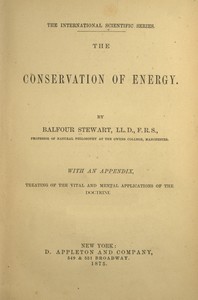
The conservation of energy
Written by Balfour Stewart
Chaptra reads alongside you — AI insights, chapter breakdowns and reader discussions for every book. Join free
About this book
Reading guide
Themes, characters and key ideas in The conservation of energy, written by Chaptra AI.
- about 8 hours
- intermediate
- Informative
- Didactic
- Analytical
Balfour Stewart's "The Conservation of Energy" is a seminal late 19th-century scientific publication from the International Scientific Series, designed to demystify the fundamental principle of energy conservation. Stewart systematically explores the nature of energy, its various forms (kinetic, potential), and its transformations across disciplines like physics, biology, and psychology. The text emphasizes understanding the universal laws governing collective phenomena, even while acknowledging the limitations of human knowledge regarding individual particles. Through accessible language and everyday examples, Stewart aims to educate both lay readers and scientists on the profound implications of energy conservation for understanding the universe.
“Our ignorance of individual particles while highlighting the laws governing collective phenomena.”
Key themes
- The Conservation of Energy
- This is the central and overarching theme of the book, exploring the fundamental law that energy in an isolated system remains constant over time. Stewart details how energy cannot be created or destroyed, only transformed from one form to another. He presents this as a universal principle governing all natural phenomena.
- Energy Transformation and Interconversion
- Building upon conservation, this theme focuses on the various forms energy takes (kinetic, potential, thermal, chemical, electrical, etc.) and the processes by which it changes from one form to another. Stewart illustrates these conversions with numerous examples, emphasizing the dynamic nature of energy within the universe.
- Interdisciplinary Application of Scientific Principles
- Stewart highlights how the principle of energy conservation transcends disciplinary boundaries, finding relevance and application in physics, biology, and psychology. This theme underscores the unity of scientific laws and encourages a holistic view of natural phenomena, suggesting that fundamental principles can illuminate understanding across seemingly disparate fields.
Worth discussing
How does Stewart's approach to explaining complex scientific concepts to a general audience compare to modern science communication?
Chapter-by-chapter breakdowns, character arcs and the full thematic analysis come with a free account.
Discussions
No one has started one yet
Questions this book opens up
No discussions yet
Be the first to start a discussion about this book!
Sign up to start the discussionReviews
No reviews yet
Be the first to review this book!