
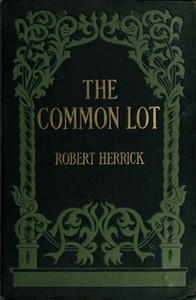
The Common Lot
Written by Robert Herrick
Chaptra reads alongside you — AI insights, chapter breakdowns and reader discussions for every book. Join free
About this book
Reading guide
Themes, characters and key ideas in The Common Lot, written by Chaptra AI.
- about 8 hours
- intermediate
- somber
- reflective
- thought-provoking
Robert Herrick's "The Common Lot" is an early 20th-century novel that commences with the funeral of Powers Jackson, a powerful self-made industrialist. The narrative centers on his nephew, Jackson Hart, a young architect, who grapples with his complicated relationship with his late uncle and the profound impact of his death. A shocking will reveals Powers Jackson's vast fortune is largely bequeathed to a school for working-class children, leaving Jackson Hart with a modest inheritance. This unexpected turn forces Jackson to confront his identity and ambitions, setting the stage for a compelling exploration of wealth, class, and moral choices in a bustling, ambition-driven city.
“No specific quotes are provided in the automatically generated summary. A full analysis would require access to the text itself.”
Key themes
- Wealth and Philanthropy
- The central theme, explored through Powers Jackson's vast fortune and his unexpected philanthropic will. It raises questions about the responsibility of wealth, its distribution, and its potential for societal good versus individual inheritance. The novel likely contrasts the accumulation of wealth with its ethical deployment.
- Identity and Ambition
- This theme is central to Jackson Hart's personal journey. His identity is initially tied to his uncle's support and influence, but the will forces him to redefine who he is and what his ambitions truly are, independent of inherited wealth. It explores the struggle to find authentic purpose.
- Class Struggle and Social Inequality
- Explicitly addressed through the purpose of Powers Jackson's philanthropic act: a school for working-class children. This highlights the stark divisions within society and the efforts (or lack thereof) to bridge the gap between the privileged and the less fortunate. The novel likely critiques the social structures of its time.
Worth discussing
How does Powers Jackson's will challenge conventional notions of legacy and inheritance?
Chapter-by-chapter breakdowns, character arcs and the full thematic analysis come with a free account.
Discussions
No one has started one yet
Questions this book opens up
No discussions yet
Be the first to start a discussion about this book!
Sign up to start the discussionReviews
No reviews yet
Be the first to review this book!