
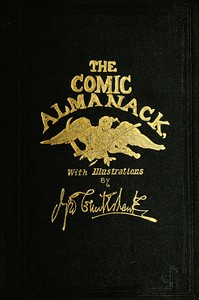
The Comic Almanack, Volume 2: An Ephemeris in Jest and Earnest, Containing Merry Tales, Humerous Poetry, Quips, and Oddities
Written by William Makepeace Thackeray,Henry Mayhew,Gilbert Abbott À Beckett,Horace Mayhew,Albert Smith
Chaptra reads alongside you — AI insights, chapter breakdowns and reader discussions for every book. Join free
About this book
Read it with a club
Small groups reading the same books and talking as they go.


News
- 4 members
- 1,813 discussions
- Active Sep 11
Read The Comic Almanack, Volume 2: An Ephemeris in Jest and Earnest, Containing Merry Tales, Humerous Poetry, Quips, and Oddities alongside people who are reading it too.
Also here: News Bulletin, Just Joking....
Chaptra Prime — paid clubs, every club feature, and unlimited reading support, for $5 a month or $60 once.
See PrimeReading guide
Themes, characters and key ideas in The Comic Almanack, Volume 2: An Ephemeris in Jest and Earnest, Containing Merry Tales, Humerous Poetry, Quips, and Oddities, written by Chaptra AI.
- about 8 hours
- intermediate
- humorous
- satirical
- witty
The Comic Almanack, Volume 2, is a vibrant mid-19th century anthology crafted by an assembly of prominent British humorists and satirists, including Thackeray and the Mayhews. This collection serves as a lively snapshot of Victorian society, blending witty observations, satirical poetry, and humorous prose with illustrative embellishments. It navigates contemporary issues, from the intricacies of Parliament and economic advice to everyday concerns like emigration and gardening, all through a distinctly lighthearted yet incisive lens. The volume masterfully employs jest and insightful commentary to entertain readers while subtly provoking thought on the societal norms and political landscape of its era, making it a significant artifact of popular Victorian humor.
“One might say Parliament is a grand theatre, where the players are ever so earnest, and the audience ever so bewildered.”
Key themes
- Social and Political Satire
- This theme is central to the almanack, using humor to critique and comment on the social structures, political institutions, and public figures of Victorian Britain. It targets the perceived absurdities and hypocrisies of Parliament, economic policies, and various societal norms, offering a lighthearted yet pointed commentary on the state of the nation. The satire often functions as a means of both entertainment and subtle social reform, encouraging readers to view their world with a critical, albeit amused, eye.
- Everyday Life and Human Foibles
- Beyond grand political statements, the almanack meticulously observes and humorously portrays the mundane yet significant aspects of daily Victorian life. This includes the trials and tribulations of domesticity, leisure activities, personal aspirations, and the universal human tendency towards minor absurdities. Topics like gardening, emigration, and personal predictions are explored with a blend of wit and empathy, making the content relatable to its original readership and offering insights into the common experiences of the time.
- The Nature and Function of Humor
- The almanack itself is a testament to the power and versatility of humor. It implicitly explores how humor can be used not just for entertainment, but also as a vehicle for social commentary, a means of coping with societal pressures, and a way to simplify or demystify complex issues. The collaboration of multiple authors also highlights the diverse forms and applications of comedic writing, from puns and wordplay to irony and caricature, demonstrating humor's capacity to engage, provoke, and unify an audience.
Worth discussing
How does the humor in 'The Comic Almanack' reflect the social and political concerns of mid-19th century Britain?
Chapter-by-chapter breakdowns, character arcs and the full thematic analysis come with a free account.
Discussions
No one has started one yet
Questions this book opens up
No discussions yet
Be the first to start a discussion about this book!
Sign up to start the discussionReviews
No reviews yet
Be the first to review this book!