
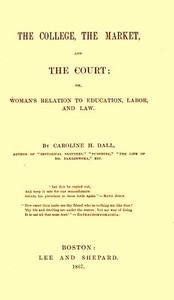
The College, the Market, and the Court: or, Woman's relation to education, labor and law
Written by Caroline Wells Healey Dall
Chaptra reads alongside you — AI insights, chapter breakdowns and reader discussions for every book. Join free
About this book
Read it with a club
Small groups reading the same books and talking as they go.


News
- 4 members
- 1,813 discussions
- Active Sep 11
Read The College, the Market, and the Court: or, Woman's relation to education, labor and law alongside people who are reading it too.
Also here: News Bulletin, Just Joking....
Chaptra Prime — paid clubs, every club feature, and unlimited reading support, for $5 a month or $60 once.
See PrimeReading guide
Themes, characters and key ideas in The College, the Market, and the Court: or, Woman's relation to education, labor and law, written by Chaptra AI.
- about 10 hours
- advanced
- intellectual
- challenging
- reformist
Caroline Wells Healey Dall's "The College, the Market, and the Court" is a pivotal mid-19th century collection of essays advocating for women's comprehensive emancipation. Dall critically examines the systemic barriers women face in education, labor, and law, passionately arguing for equal access and recognition within society. The work highlights her personal struggles against public resistance to her radical views, framing education not merely as a privilege but a fundamental right crucial for women's societal contributions. Through historical context and incisive critique, Dall challenges the prevailing status quo, seeking to transform public opinion and legal frameworks to achieve genuine gender equality.
“Education is not a privilege, but a fundamental right that encompasses the freedom to choose one's vocation and engage meaningfully in society.”
Key themes
- Education as a Fundamental Right
- Dall passionately argues that education is not a privilege to be selectively granted but an inherent human right essential for intellectual development, moral growth, and the full realization of individual potential. She critiques the limited educational opportunities available to women in her era, asserting that denying them comprehensive education not only stifles individual genius but also deprives society of invaluable contributions. This theme underscores her belief that education is the bedrock for women's emancipation in all other spheres.
- Gender Equality and Social Justice
- This overarching theme drives Dall's entire work. She challenges the patriarchal structures and societal norms that relegate women to a subordinate status, advocating for their full emancipation and recognition as equal citizens. Dall critiques the systemic injustices embedded in social customs, economic practices, and legal frameworks, arguing for a society where gender does not dictate an individual's rights, opportunities, or value.
- Legal Reform and Civil Rights
- Dall meticulously dissects the legal disenfranchisement of women, particularly their lack of property rights, limited legal standing, and absence of suffrage. She advocates for fundamental legal reforms that would grant women full civil rights, enabling them to own property, enter contracts, testify in court, control their earnings, and participate in the political process. This theme underscores the necessity of legislative change to dismantle institutionalized gender inequality.
Worth discussing
How does Dall's personal experience of facing public resistance influence the tone and argumentative strategy of her work?
Chapter-by-chapter breakdowns, character arcs and the full thematic analysis come with a free account.
Discussions
No one has started one yet
Questions this book opens up
No discussions yet
Be the first to start a discussion about this book!
Sign up to start the discussionReviews
No reviews yet
Be the first to review this book!