
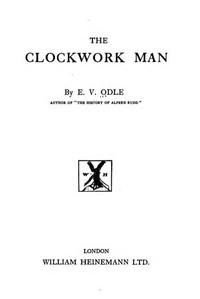
The Clockwork Man
Written by E. V. (Edwin Vincent) Odle
Chaptra reads alongside you — AI insights, chapter breakdowns and reader discussions for every book. Join free
About this book
Reading guide
Themes, characters and key ideas in The Clockwork Man, written by Chaptra AI.
- about 6 hours
- intermediate
- whimsical
- mysterious
- philosophical
E. V. Odle's "The Clockwork Man" is a seminal, yet often overlooked, work of early science fiction that introduces a peculiar visitor from the future into 1920s England. This enigmatic figure, powered by visible clockwork mechanisms and capable of manipulating local time, profoundly disrupts the lives of those he encounters, particularly the bewildered narrator. The novel masterfully blends philosophical inquiry with whimsical absurdity, exploring the nature of humanity, the impact of technology, and the fluidity of time. Through the Clockwork Man's alien perspective and the reactions of the contemporary characters, Odle crafts a unique commentary on societal norms and the inexorable march of progress. It stands as a fascinating precursor to later discussions on artificial intelligence, transhumanism, and the paradoxes of time travel.
“"My heart is a clock, and it controls time."”
Key themes
- The Nature of Humanity and Identity
- Central to the novel is the question of what truly defines a human being. The Clockwork Man, despite his mechanical heart and alien origins, exhibits curiosity, frustration, and even love, forcing characters and readers to re-evaluate the boundaries between man and machine, and between biology and consciousness. Odle explores whether humanity lies in our physical form, our emotions, or our capacity for thought and experience.
- The Subjectivity and Manipulation of Time
- Odle uses the Clockwork Man's ability to stop and start his internal clockwork as a primary vehicle for exploring the nature of time. This power not only creates humorous and disorienting scenarios but also delves into the idea that time is not a fixed, objective constant but can be perceived and even manipulated, leading to profound questions about cause and effect, free will, and the linearity of existence.
- Technology, Progress, and Social Critique
- The novel, published in the interwar period, reflects early 20th-century anxieties and fascinations with technology. The Clockwork Man embodies both the marvel and the potential dehumanization of advanced technology. Odle uses his alien perspective to subtly critique the social norms, class structures, and technological advancements (or lack thereof) of his contemporary society, often with a satirical edge.
Worth discussing
How does Odle use the Clockwork Man's unique abilities to explore the subjective nature of time and reality?
Chapter-by-chapter breakdowns, character arcs and the full thematic analysis come with a free account.
Discussions
No one has started one yet
Questions this book opens up
No discussions yet
Be the first to start a discussion about this book!
Sign up to start the discussionReviews
No reviews yet
Be the first to review this book!