
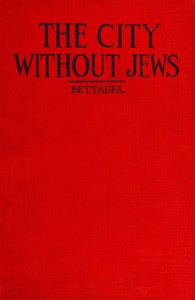
The city without Jews : $b A novel of our time
Written by Hugo Bettauer
Chaptra reads alongside you — AI insights, chapter breakdowns and reader discussions for every book. Join free
About this book
This work by Bettauer, Hugo offers readers a unique literary experience. The narrative explores themes of jews and antisemitism.
Read it with a club
Small groups reading the same books and talking as they go.


News
- 4 members
- 1,813 discussions
- Active Sep 11
Read The city without Jews : $b A novel of our time alongside people who are reading it too.
Also here: News Bulletin, Just Joking....
Chaptra Prime — paid clubs, every club feature, and unlimited reading support, for $5 a month or $60 once.
See PrimeReading guide
Themes, characters and key ideas in The city without Jews : $b A novel of our time, written by Chaptra AI.
- about 3 hours
- intermediate
- prophetic
- somber
- cautionary
Hugo Bettauer's prophetic 1922 novel, "The City Without Jews," imagines a near-future Vienna where antisemitic sentiment culminates in the expulsion of its entire Jewish population. Initially, the non-Jewish citizens celebrate, anticipating a utopian society free from perceived 'foreign' influence. However, the city quickly descends into economic collapse, cultural stagnation, and social decay as it grapples with the unforeseen consequences of losing its vibrant, integral Jewish community. The narrative explores the devastating impact of xenophobia and prejudice, ultimately leading the city to recognize its grave error and attempt to reverse the expulsion.
“"The Jews are not a race, but a community of destiny."”
Key themes
- Antisemitism and Xenophobia
- The central theme, exploring the dangers of scapegoating a minority group for societal problems. Bettauer demonstrates how prejudice, when institutionalized, leads to self-destruction for the perpetrators as much as it devastates the victims. It highlights the irrationality and destructive power of hatred based on identity.
- Economic Interdependence
- The novel meticulously illustrates how the removal of one segment of society, particularly one deeply integrated into commerce and culture, can cripple an entire city. It argues that diversity is not just a moral good but an economic necessity, showing how different groups contribute uniquely and collectively to prosperity.
- Identity and Belonging
- The book explores what it means to belong to a place and how that belonging can be violently severed. It examines both the individual's sense of self when displaced and a city's identity when it sheds a fundamental part of its character. It questions whether a collective identity can be artificially purified without losing its essence.
Worth discussing
How does Bettauer's novel serve as a warning, and what makes it so chillingly prophetic given subsequent historical events?
Chapter-by-chapter breakdowns, character arcs and the full thematic analysis come with a free account.
Discussions
No one has started one yet
Questions this book opens up
No discussions yet
Be the first to start a discussion about this book!
Sign up to start the discussionReviews
No reviews yet
Be the first to review this book!