
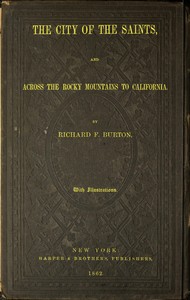
The City of the Saints, and Across the Rocky Mountains to California
Written by Richard Francis Burton
Chaptra reads alongside you — AI insights, chapter breakdowns and reader discussions for every book. Join free
About this book
Reading guide
Themes, characters and key ideas in The City of the Saints, and Across the Rocky Mountains to California, written by Chaptra AI.
- about 15 hours
- advanced
- exploratory
- observational
- historical
Sir Richard F. Burton's "The City of the Saints, and Across the Rocky Mountains to California" is a seminal 19th-century travelogue chronicling his arduous journey through the American West to Great Salt Lake City and beyond. Driven by both scholarly curiosity and an adventurous spirit, Burton meticulously observes the nascent Mormon settlements, their unique societal structures, and the challenging frontier landscape. The narrative delves into the political tensions of the era, including conflicts with indigenous peoples and the broader implications of American expansion. Through his detailed firsthand account, Burton offers a crucial historical snapshot of a pivotal period in American history, blending keen ethnographic observation with the thrill of exploration.
“"The wild West, with its dangers and its boundless possibilities, ever calls to the adventurous spirit."”
Key themes
- Cultural Encounter and Othering
- A core theme is Burton's encounter with and detailed analysis of the Mormon community, a distinct culture within the broader American context. He observes their unique social structures, religious practices (especially polygamy), and economic systems. This theme also extends to his observations of indigenous peoples. Burton's narrative, while attempting objectivity, often reflects the 'othering' inherent in 19th-century colonial ethnography, viewing these cultures through a European lens of judgment and classification.
- Exploration and Frontierism
- The book extensively details the physical and psychological challenges of traversing the American frontier in the mid-19th century. It explores the vastness of the landscape, the dangers posed by nature and indigenous tribes, and the spirit of adventure that drove individuals like Burton and the Mormon pioneers into the wilderness. It's a study of human endurance against a formidable natural backdrop.
- Religious and Social Experimentation
- The book serves as a primary account of one of the most significant religious and social experiments in American history: the establishment of the Mormon commonwealth in Utah. Burton examines the foundations of their faith, the practical application of their doctrines in daily life, and the challenges they faced in building a self-sufficient society based on distinct religious principles. It explores how a unique belief system can shape an entire civilization.
Worth discussing
How does Burton's 19th-century perspective influence his observations of Mormon society and indigenous cultures? Can we separate the valuable historical data from his inherent biases?
Chapter-by-chapter breakdowns, character arcs and the full thematic analysis come with a free account.
Discussions
No one has started one yet
Questions this book opens up
No discussions yet
Be the first to start a discussion about this book!
Sign up to start the discussionReviews
No reviews yet
Be the first to review this book!