
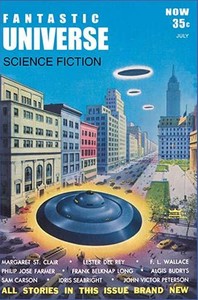
The celestial blueprint
Written by Philip José Farmer
Chaptra reads alongside you — AI insights, chapter breakdowns and reader discussions for every book. Join free
About this book
Reading guide
Themes, characters and key ideas in The celestial blueprint, written by Chaptra AI.
- about 8 hours
- intermediate
- dark
- ironic
- dystopian
Philip José Farmer's "The Celestial Blueprint" is a mid-20th-century science fiction novel that plunges into a dystopian future governed by an unyielding, scripture-based societal structure. The narrative centers on B. T. Revanche, a vindictive financier seeking retribution against the dogmatic city of Dafess, which once ostracized him. Collaborating with the eccentric artist Da Vincelleo, Revanche devises an elaborate scheme to weaponize Dafess's own religious prophecies against its unsuspecting citizens. As the populace eagerly awaits a promised salvation, they are instead confronted by robotic enforcers – a twisted manifestation of their beliefs – leading to a chaotic and darkly humorous climax that profoundly critiques justice and vengeance.
“"The Blueprint dictates all, yet it is the human heart, twisted by its own interpretation, that truly writes our fate."”
Key themes
- Revenge and Retribution
- The central driving force of the narrative, explored through B. T. Revanche's single-minded quest to exact vengeance on the society that wronged him. The novel questions the morality and consequences of seeking retribution, especially when it mirrors the cruelty it seeks to punish.
- Rigid Belief Systems and Dogma
- The novel critically examines the dangers of a society governed by an absolute, unquestioning belief structure—the 'Celestial Blueprint.' It highlights how such systems can lead to oppression, marginalization, and a disconnect from reality, ultimately making the society vulnerable to its own tenets.
- Art, Ambition, and Subversion
- This theme explores the role of creative genius and ambition, particularly through Da Vincelleo, as a force that can either perpetuate or violently disrupt societal norms. Art, in this context, becomes a weapon for exposing hypocrisy and enacting change, albeit destructive change.
Worth discussing
How does 'The Celestial Blueprint' critique rigid belief systems, and what are the contemporary implications of such critiques?
Chapter-by-chapter breakdowns, character arcs and the full thematic analysis come with a free account.
Discussions
No one has started one yet
Questions this book opens up
No discussions yet
Be the first to start a discussion about this book!
Sign up to start the discussionReviews
No reviews yet
Be the first to review this book!