
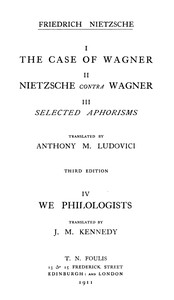
The Case of Wagner: Complete Works, Volume 8
Written by Friedrich Wilhelm Nietzsche
Chaptra reads alongside you — AI insights, chapter breakdowns and reader discussions for every book. Join free
About this book
Reading guide
Themes, characters and key ideas in The Case of Wagner: Complete Works, Volume 8, written by Chaptra AI.
- about 10 hours
- advanced
- philosophical
- critical
- polemical
Friedrich Nietzsche's "The Case of Wagner" is a trenchant philosophical treatise examining the pervasive influence of Richard Wagner's music and ideology on late 19th-century European culture. Written as a deeply personal and polemical critique, Nietzsche dissects Wagner's art as a symptom and symbol of cultural decadence, contrasting its captivating allure with its perceived moral and intellectual detriment. The work chronicles Nietzsche's profound transformation from a fervent admirer to a severe critic, articulating his struggle against what he saw as Wagner's promotion of weakness, sentimentality, and a retreat from life-affirming values. Through an impassioned analysis of themes like artistry, decadence, and the role of music in modern society, Nietzsche challenges readers to re-evaluate the foundations of contemporary artistic expression and cultural health.
“I have broken with Wagner, I have suffered from Wagner, I have recovered from Wagner...”
Key themes
- Decadence and Modernity
- Nietzsche argues that Wagner's art is the ultimate symptom and symbol of cultural decadence in modern Europe. Decadence, for Nietzsche, signifies a decline in life-affirming values, a weakening of the will, and a preference for the sentimental, the intoxicating, and the illusory over the strong, the rigorous, and the truthful. He sees Wagner's music and dramatic themes as pandering to a 'sick' audience, reflecting a society in decline rather than one striving for greatness and health.
- The Purpose and Health of Art
- A core aspect of Nietzsche's critique is his vision for what art *should* be. For him, true art should be life-affirming, challenging, and a source of strength and health, even if it confronts harsh truths. He condemns Wagner's art as 'sick' because he believes it serves as an escape, a palliative, or a manipulation of emotions, rather than a catalyst for self-overcoming and the affirmation of life. He advocates for an art that invigorates and elevates, rather than one that enervates and seduces.
- Personal Transformation and Self-Overcoming
- The book is deeply autobiographical in its intellectual content, reflecting Nietzsche's profound and painful struggle to liberate himself from the powerful influence of Wagner. This 'case' against Wagner is simultaneously a case for Nietzsche's own philosophical independence and a testament to his concept of 'self-overcoming' – the process of continually challenging and transcending one's own beliefs, attachments, and weaknesses. It highlights the difficulty and necessity of intellectual honesty, even when it means breaking with beloved figures.
Worth discussing
How does Nietzsche's personal relationship with Wagner influence his critique, and can a critic truly be objective when deeply personally invested?
Chapter-by-chapter breakdowns, character arcs and the full thematic analysis come with a free account.
Discussions
No one has started one yet
Questions this book opens up
No discussions yet
Be the first to start a discussion about this book!
Sign up to start the discussionReviews
No reviews yet
Be the first to review this book!