
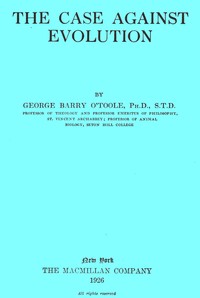
The case against evolution
Written by George Barry O'Toole
Chaptra reads alongside you — AI insights, chapter breakdowns and reader discussions for every book. Join free
About this book
Reading guide
Themes, characters and key ideas in The case against evolution, written by Chaptra AI.
- about 12 hours
- advanced
- Analytical
- Skeptical
- Academic
George Barry O'Toole's "The Case Against Evolution" is an early 20th-century scientific critique that challenges the prevailing theory of evolution, urging rigorous scrutiny over uncritical acceptance. The book opens by identifying a contemporary crisis in evolutionary thought, fueled by new insights from genetics and paleontology that questioned established Darwinian principles. O'Toole meticulously differentiates between observable variations within species and the unproven concept of gradual species transmutation, arguing the latter lacks empirical support. His work serves as a philosophical and scientific inquiry, aiming to systematically dismantle mainstream evolutionary theories through detailed analysis and argumentation. Ultimately, it presents a compelling case for skepticism regarding the completeness and dogmatic assertion of evolutionary theory at the time.
“"The current crisis in evolutionary thought demands a rigorous re-examination of its foundational tenets."”
Key themes
- Critique of Scientific Dogma
- O'Toole's central argument is that evolutionary theory, particularly Darwinism, was being accepted uncritically, almost as a dogma, rather than remaining subject to rigorous scientific scrutiny. He questions the intellectual honesty of such acceptance and advocates for a more skeptical and evidence-based approach to scientific theories.
- Nature of Scientific Evidence
- The book deeply explores what constitutes valid scientific evidence, particularly in the context of historical processes like evolution. O'Toole emphasizes the distinction between directly observable phenomena (like variations within species) and inferential leaps (like the gradual transmutation of species over vast timescales), arguing that the latter requires a higher standard of proof which he believes was not met by the evidence available in his time.
- The Impact of New Scientific Discoveries
- O'Toole highlights how contemporary advancements in genetics and paleontology were not necessarily confirming traditional Darwinian views but were, in fact, raising 'fundamental issues' that challenged them. This theme explores the dynamic nature of scientific understanding and how new data can force a re-evaluation of established theories.
Worth discussing
How does O'Toole's critique reflect the scientific understanding and debates of the early 20th century?
Chapter-by-chapter breakdowns, character arcs and the full thematic analysis come with a free account.
Discussions
No one has started one yet
Questions this book opens up
No discussions yet
Be the first to start a discussion about this book!
Sign up to start the discussionReviews
No reviews yet
Be the first to review this book!