
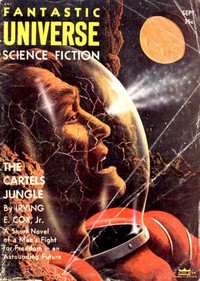
The Cartels Jungle
Written by Irving E. Cox
Chaptra reads alongside you — AI insights, chapter breakdowns and reader discussions for every book. Join free
About this book
Reading guide
Themes, characters and key ideas in The Cartels Jungle, written by Chaptra AI.
- about 8 hours
- intermediate
- dark
- dystopian
- suspenseful
Irving E. Cox, Jr.'s "The Cartels Jungle" is a mid-20th-century science fiction novel set in a grim dystopian future where powerful cartels dictate human society. The narrative follows Captain Max Hunter, who returns to Earth to marry his love, Ann Saymer, only to find her missing amidst a web of cartel intrigues. Ann, a brilliant inventor, has created the 'Exorciser,' a psychiatric device that becomes the focal point of a sinister plot for societal manipulation. Hunter's desperate quest to find Ann unravels a conspiracy involving the cartels and the Union of Free Workers, forcing him to confront profound questions about free will, power, and the ethical implications of technology. The story culminates in a challenging examination of humanity's struggle for control and autonomy in a morally compromised world.
“"In this jungle, the only law is power, and the only freedom is the illusion of choice."”
Key themes
- Control vs. Free Will
- This is the central conflict of the novel, explored through the cartels' and Union's desire to use the 'Exorciser' to manipulate and dominate society. The story questions the nature of individual autonomy in a world where external forces seek to dictate thoughts and actions, and Max Hunter's quest becomes a fight for the fundamental right to self-determination.
- Technological Ethics and Consequences
- The novel critically examines the double-edged sword of technological advancement. Ann Saymer's 'Exorciser,' intended for psychiatric healing, becomes a tool for domination, highlighting how powerful inventions can be perverted from their original purpose and lead to unforeseen, catastrophic societal consequences if not handled ethically.
- Power and Ambition
- The entire societal structure of "The Cartels Jungle" is built upon the relentless pursuit and struggle for power among various factions. The novel illustrates how ambition, when unchecked by moral considerations, can lead to corruption, oppression, and a morally decaying world, where individuals are mere pawns in larger power games.
Worth discussing
How does 'The Cartels Jungle' reflect mid-20th-century anxieties about technology and control, and how do these anxieties remain relevant today?
Chapter-by-chapter breakdowns, character arcs and the full thematic analysis come with a free account.
Discussions
No one has started one yet
Questions this book opens up
No discussions yet
Be the first to start a discussion about this book!
Sign up to start the discussionReviews
No reviews yet
Be the first to review this book!