
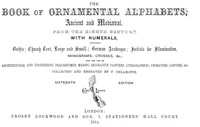
The Book of Ornamental Alphabets, Ancient and Medieval, from the Eighth Century: With Numerals, including Gothic; Church Text, Large and; Small; German Arabesque; Initials for Illumination,; Monograms, Crosses, &c.
Written by F. (Freeman) Delamotte
Chaptra reads alongside you — AI insights, chapter breakdowns and reader discussions for every book. Join free
About this book
Reading guide
Themes, characters and key ideas in The Book of Ornamental Alphabets, Ancient and Medieval, from the Eighth Century: With Numerals, including Gothic; Church Text, Large and; Small; German Arabesque; Initials for Illumination,; Monograms, Crosses, &c., written by Chaptra AI.
- about 15 hours
- intermediate
- Informative
- Historical
- Artistic
F. Delamotte's "The Book of Ornamental Alphabets, Ancient and Medieval, from the Eighth Century" is a pivotal early 20th-century reference work meticulously cataloging the evolution of decorative letterforms. Spanning from the eighth to the sixteenth century, this collection provides a comprehensive visual survey of historical alphabets, numerals, and decorative elements like Gothic, Arabesque, and illuminated initials. Primarily aimed at artists, craftsmen, and draughtsmen, the book serves as an invaluable practical resource for design and scholarly study. Its systematic organization and detailed illustrations highlight the rich diversity and cultural significance of letterforms across various historical periods, making it an essential guide for understanding the heritage of typography.
“The overall theme emphasizes the richness and diversity of letterforms across centuries and cultural contexts.”
Key themes
- Evolution of Letterforms
- This theme explores the chronological development and stylistic changes of alphabets and numerals from the 8th to the 16th century. It showcases how letterforms adapted to different writing materials, cultural influences, and aesthetic preferences, demonstrating a continuous lineage of design innovation.
- Artistic Heritage and Preservation
- The book serves as a monument to the artistic legacy of ancient and medieval scribes, illustrators, and craftsmen. It emphasizes the importance of documenting and preserving these historical artifacts, making them accessible for study and inspiration, thereby ensuring their continued influence on future generations.
- Practical Application in Craft
- Beyond its historical value, the book is designed as a practical tool for artists and craftsmen. It provides concrete visual examples that can be directly applied in fields such as architectural drawing, masonry, decorative painting, and graphic design, bridging historical art with contemporary practice.
Worth discussing
How does the evolution of letterforms reflect broader cultural and technological changes across different historical periods?
Chapter-by-chapter breakdowns, character arcs and the full thematic analysis come with a free account.
Discussions
No one has started one yet
Questions this book opens up
No discussions yet
Be the first to start a discussion about this book!
Sign up to start the discussionReviews
No reviews yet
Be the first to review this book!