
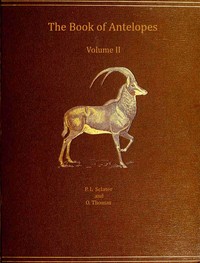
The book of antelopes, vol. 2 (of 4)
Written by Philip Lutley Sclater,Oldfield Thomas
Chaptra reads alongside you — AI insights, chapter breakdowns and reader discussions for every book. Join free
About this book
Reading guide
Themes, characters and key ideas in The book of antelopes, vol. 2 (of 4), written by Chaptra AI.
- about 15 hours
- advanced
- informative
- systematic
- detailed
"The Book of Antelopes, Vol. 2" by Sclater and Thomas is a seminal late 19th-century scientific publication meticulously cataloging various antelope species. This volume specifically continues a detailed examination, focusing on the classification, anatomy, and geographical distribution of antelopes, particularly delving into the subfamily Neotraginae. It serves as an authoritative reference for naturalists and zoologists, providing thorough descriptions, anatomical features, and ecological habits of species like the Klipspringer and Cape Oribi. Through detailed text and illustrations, the authors contribute significantly to the understanding of antelope biology and their systematic placement within the animal kingdom, embodying the scientific rigor of its era.
“"The Neotraginae form a well-defined subfamily of small antelopes, characterized by their diminutive size and peculiar cranial and dental structures."”
Key themes
- Scientific Classification and Taxonomy
- The central theme is the systematic organization and classification of antelope species. The book meticulously outlines the characteristics that define subfamilies, genera, and species, demonstrating the scientific process of grouping organisms based on shared morphological and anatomical features. This reflects the foundational work in establishing a coherent biological nomenclature.
- Biodiversity and Adaptation
- The book showcases the immense diversity within the antelope family and highlights how different species have adapted to specific ecological niches. It details the unique anatomical features and behaviors that allow species like the Klipspringer to thrive in rocky terrains, or the Oribi in grasslands, illustrating the principle of natural selection and ecological specialization.
- Scientific Observation and Documentation
- This volume is a testament to the importance of meticulous observation and detailed documentation in scientific inquiry. The authors rely on careful examination of specimens and reports from the field to compile comprehensive descriptions. This theme underscores the empirical foundation of natural history and the process of building scientific knowledge through rigorous data collection.
Worth discussing
How does the scientific methodology presented in this volume compare to modern zoological research methods?
Chapter-by-chapter breakdowns, character arcs and the full thematic analysis come with a free account.
Discussions
No one has started one yet
Questions this book opens up
No discussions yet
Be the first to start a discussion about this book!
Sign up to start the discussionReviews
No reviews yet
Be the first to review this book!