
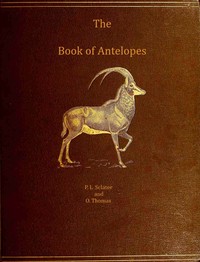
The book of antelopes, vol. 1 (of 4)
Written by Philip Lutley Sclater,Oldfield Thomas
Chaptra reads alongside you — AI insights, chapter breakdowns and reader discussions for every book. Join free
About this book
Reading guide
Themes, characters and key ideas in The book of antelopes, vol. 1 (of 4), written by Chaptra AI.
- about 20 hours
- advanced
- academic
- informative
- detailed
"The Book of Antelopes, Vol. 1 (of 4)" by Philip Lutley Sclater and Oldfield Thomas is a monumental late 19th-century zoological study dedicated to the detailed classification and description of various antelope species. This inaugural volume, born from collaborative scientific efforts and originally conceived by the late Sir Victor Alexander Brooke, combines rigorous scientific descriptions with engaging illustrations, aiming to significantly contribute to the field of natural history. It meticulously outlines the physical characteristics, habitats, and taxonomic positions of antelopes, reflecting the scientific methodologies and knowledge of its era. The work serves as an essential reference for zoologists, naturalists, and anyone interested in the history of wildlife biology and mammalian taxonomy, setting a high standard for comprehensive biological documentation.
“"To the memory of Sir Victor Alexander Brooke, Bart., whose untimely death in 1891 deprived Zoology of one of its most ardent and successful students, and to whom the original idea of this work is due, this first volume is reverently dedicated by the Authors."”
Key themes
- Scientific Classification and Taxonomy
- The central theme of the book is the systematic organization and classification of antelope species. It meticulously details the distinguishing features, measurements, and historical taxonomic placement of each species, reflecting the scientific imperative of categorizing the natural world. This theme underscores the authors' commitment to establishing a coherent and comprehensive framework for understanding antelope biodiversity.
- Detailed Observation and Documentation
- The book exemplifies the Victorian era's emphasis on meticulous observation and thorough documentation in natural history. The authors provide exhaustive descriptions, often based on specimens, field notes, and reports from various contributors, demonstrating a commitment to empirical data collection as the basis for scientific knowledge.
- Collaboration and Legacy in Science
- The work explicitly highlights the collaborative nature of scientific progress, crediting numerous contributors and acknowledging the foundational concept originated by Sir Victor Alexander Brooke. This theme emphasizes that large-scale scientific endeavors are rarely the product of a single individual but rather a collective effort built upon the contributions and inspirations of many.
Worth discussing
How does 'The Book of Antelopes' reflect the state of zoological science and classification methods in the late 19th century?
Chapter-by-chapter breakdowns, character arcs and the full thematic analysis come with a free account.
Discussions
No one has started one yet
Questions this book opens up
No discussions yet
Be the first to start a discussion about this book!
Sign up to start the discussionReviews
No reviews yet
Be the first to review this book!