
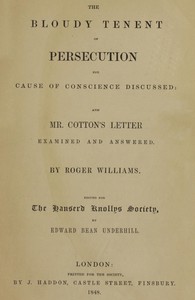
The Bloudy Tenent of Persecution for Cause of Conscience Discussed and Mr. Cotton's Letter Examined and Answered
Written by Roger Williams
Chaptra reads alongside you — AI insights, chapter breakdowns and reader discussions for every book. Join free
About this book
Reading guide
Themes, characters and key ideas in The Bloudy Tenent of Persecution for Cause of Conscience Discussed and Mr. Cotton's Letter Examined and Answered, written by Chaptra AI.
- about 25 hours
- advanced
- Philosophical
- Argumentative
- Polemical
Roger Williams' "The Bloudy Tenent of Persecution" is a foundational theological and political treatise from the 17th century, vehemently arguing for religious freedom and the strict separation of church and state. Written as a polemical response to John Cotton, Williams systematically refutes the notion that civil authorities have the right to enforce religious conformity or punish dissenters. He posits that true faith must be voluntary and uncoerced, contending that state-sponsored religion inevitably leads to hypocrisy, violence, and the corruption of both civil governance and spiritual life. The work stands as a powerful defense of individual conscience and a seminal text in the development of American principles of religious liberty.
“God requireth not a uniformity of religion to be enacted and enforced in any civil state; which enforced uniformity (sooner or later) is the greatest occasion of civil war, ravishing of conscience, persecution of Christ Jesus in his members, and of the hypocrisy and destruction of millions of souls.”
Key themes
- Religious Freedom / Liberty of Conscience
- This is the central, overarching theme of the book. Williams argues passionately that every individual has an inherent right to worship or not worship according to their own conscience, free from any coercion or interference by civil authorities. He believes that true faith cannot be compelled and that forcing religious conformity is a 'spiritual rape' of the soul.
- Separation of Church and State
- Williams advocates for a clear and absolute distinction between the civil sphere (the 'wilderness' or 'world') and the ecclesiastical sphere (the 'garden' of the church). He argues that the civil magistrate's power extends only to civil matters, not spiritual ones, and that mixing the two corrupts both institutions. This separation is crucial for preserving the purity of the church and the peace of the state.
- Critique of Persecution
- The entire treatise is a sustained argument against the practice of religious persecution. Williams details how persecution is contrary to Christ's teachings, leads to violence and suffering, creates hypocrisy, and ultimately fails to achieve genuine religious conversion. He frames it as a 'bloudy tenent' that defiles both church and state.
Worth discussing
How does Williams's concept of 'liberty of conscience' differ from modern understandings of religious freedom or secularism?
Chapter-by-chapter breakdowns, character arcs and the full thematic analysis come with a free account.
Discussions
No one has started one yet
Questions this book opens up
No discussions yet
Be the first to start a discussion about this book!
Sign up to start the discussionReviews
No reviews yet
Be the first to review this book!