
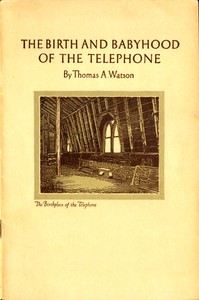
The Birth and Babyhood of the Telephone
Written by Thomas Augustus Watson
Chaptra reads alongside you — AI insights, chapter breakdowns and reader discussions for every book. Join free
About this book
Reading guide
Themes, characters and key ideas in The Birth and Babyhood of the Telephone, written by Chaptra AI.
- about 8 hours
- intermediate
- innovative
- historical
- inspiring
Thomas Augustus Watson's "The Birth and Babyhood of the Telephone" is a captivating first-person memoir recounting his pivotal role as Alexander Graham Bell's assistant during the groundbreaking invention of the telephone in the late 19th century. Spanning roughly 1874 to 1880, the book details the arduous journey of experimentation, trials, and errors that characterized the early days of telecommunication. Watson vividly describes the technical challenges, the development of various telephonic devices, and the eventual triumph of hearing Bell's voice through a wire for the first time. More than just a historical record, it highlights the immense dedication, enthusiasm, and collaborative spirit of the pioneers who laid the foundation for modern global communication.
“It was not a sudden flash of genius, but a tireless, painstaking process of trial and error, of endless adjustments and persistent hope.”
Key themes
- Innovation and Invention
- This is the core theme, exploring the arduous, iterative, and often frustrating process of creating something entirely new. The book details the scientific method in action, from initial conceptualization to practical application, highlighting the countless trials and errors inherent in groundbreaking invention. It celebrates human ingenuity and the drive to solve complex problems.
- Collaboration and Partnership
- The memoir strongly emphasizes the synergistic relationship between Alexander Graham Bell and Thomas Augustus Watson. It showcases how different skill sets – Bell's theoretical vision and Watson's practical engineering prowess – were essential for the invention's success. This theme challenges the myth of the solitary genius, illustrating the power of teamwork in scientific discovery.
- Perseverance and Dedication
- The book vividly portrays the immense dedication and unwavering perseverance required to invent the telephone. It details numerous setbacks, failures, and the sheer amount of sustained effort Bell and Watson invested. This theme underscores the psychological fortitude necessary to push through repeated disappointments and maintain focus on a long-term goal.
Worth discussing
How does Watson's first-person account challenge or reinforce common perceptions of 'lone genius' inventors?
Chapter-by-chapter breakdowns, character arcs and the full thematic analysis come with a free account.
Discussions
No one has started one yet
Questions this book opens up
No discussions yet
Be the first to start a discussion about this book!
Sign up to start the discussionReviews
No reviews yet
Be the first to review this book!