
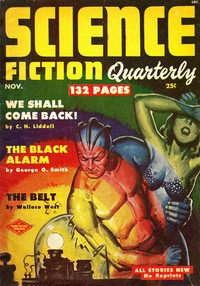
The belt
Written by Wallace West
Chaptra reads alongside you — AI insights, chapter breakdowns and reader discussions for every book. Join free
About this book
Reading guide
Themes, characters and key ideas in The belt, written by Chaptra AI.
- about 8 hours
- intermediate
- dystopian
- tragic
- bleak
Wallace West's "The Belt" is a poignant early-to-mid 20th-century science fiction novel set on New Patmos, a Caribbean island where a family's generational curse manifests through the exploitation of convict descendants. The narrative centers on Jonathan Robertson, who inherits a grim legacy of dehumanized, robotic laborers in a Lapis Lazuli factory. Jonathan's attempts to awaken the workers' lost humanity and liberate them are tragically met with resistance, as generations of servitude have rendered them incapable of comprehending freedom. The story culminates in devastating consequences, including the death of a young worker, Jo, forcing Jonathan to confront the profound and insidious nature of the island's curse.
“"The curse was not merely a legend; it was a living, breathing system of despair."”
Key themes
- Dehumanization and Exploitation
- The central theme exploring how systemic exploitation, particularly through forced labor over generations, can strip individuals of their humanity, reducing them to mere automatons devoid of thought, emotion, and agency. The book critically examines the moral cost of such systems.
- The Nature of Freedom and Servitude
- The novel delves into the complex nature of freedom, questioning whether it can be simply 'given' or if it must be 'taken' and understood. It explores the idea that generations of servitude can create a psychological state where freedom is not only unfamiliar but actively resisted, highlighting the internal as well as external barriers to liberation.
- Generational Curse and Legacy
- The book explores how the actions of one generation can create a 'curse' that plagues subsequent generations, not necessarily through supernatural means, but through the perpetuation of exploitative systems and the resulting social and psychological damage. Jonathan inherits this dark legacy, highlighting the burden of historical injustice.
Worth discussing
How does 'The Belt' define 'humanity,' and what does it mean to lose or reclaim it?
Chapter-by-chapter breakdowns, character arcs and the full thematic analysis come with a free account.
Discussions
No one has started one yet
Questions this book opens up
No discussions yet
Be the first to start a discussion about this book!
Sign up to start the discussionReviews
No reviews yet
Be the first to review this book!