
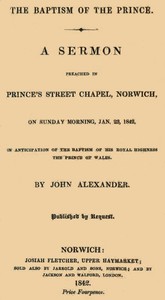
The Baptism of the Prince: A Sermon: Preached ... on Sunday morning, Jan. 23, 1842, in anticipation of the baptism of His Royal Highness, the Prince of Wales.
Written by John Alexander
Chaptra reads alongside you — AI insights, chapter breakdowns and reader discussions for every book. Join free
About this book
Reading guide
Themes, characters and key ideas in The Baptism of the Prince: A Sermon: Preached ... on Sunday morning, Jan. 23, 1842, in anticipation of the baptism of His Royal Highness, the Prince of Wales., written by Chaptra AI.
- about 1 hours
- intermediate
- Didactic
- Reverent
- Formal
John Alexander's "The Baptism of the Prince: A Sermon" is a significant religious discourse from 1842, delivered in anticipation of the Prince of Wales's baptism. The sermon serves as a theological defense of infant baptism, articulating its spiritual meaning as a sign of God's covenant and grace within a Christian context. Alexander emphasizes parental devotion and God's promise for spiritual upbringing, drawing on biblical references to Jesus's compassion for children. He critiques certain Church of England practices, particularly baptismal regeneration and the role of sponsors, advocating for parental responsibility in faith formation. Ultimately, the sermon calls upon both parents and baptized children to embrace their roles within the covenant community and cultivate a deep, personal faith.
“Baptism is not merely a ritual, but a profound sign of God's covenant and grace, particularly for our children, whom Christ himself embraced.”
Key themes
- Infant Baptism and its Theological Justification
- This is the central theme, exploring the theological rationale and spiritual significance of baptizing infants. Alexander argues for infant baptism as a sign of God's covenant and grace, connecting children to the church from an early age based on biblical precedent and Jesus's compassion for children.
- Parental Responsibility in Spiritual Nurturing
- Alexander emphasizes the paramount role of parents in the spiritual upbringing of their children, asserting that baptism places a solemn obligation upon them to guide their children towards a personal faith. He views this as a direct, personal duty, rather than one that can be fully delegated to the church or sponsors.
- Covenant Theology
- Underlying Alexander's arguments for infant baptism is a strong adherence to covenant theology, which views God's relationship with humanity as a series of covenants. Infant baptism is presented as a continuation of God's covenant with families, extending the promises and responsibilities of faith to children from birth, signifying their inclusion in the spiritual community.
Worth discussing
How does Alexander's sermon reflect the theological debates surrounding baptism in the early 19th century, particularly between nonconformist and Anglican views?
Chapter-by-chapter breakdowns, character arcs and the full thematic analysis come with a free account.
Discussions
No one has started one yet
Questions this book opens up
No discussions yet
Be the first to start a discussion about this book!
Sign up to start the discussionReviews
No reviews yet
Be the first to review this book!