
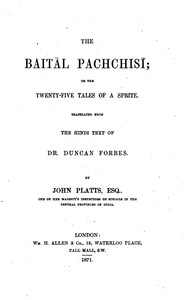
The Baitâl Pachchisi; Or, The Twenty-Five Tales of a Sprite: Translated From the Hindi Text of Dr. Duncan Forbes
Written by Lallu Lal,John T. (John Thompson) Platts,Mazhar Ali Khan Vila
Chaptra reads alongside you — AI insights, chapter breakdowns and reader discussions for every book. Join free
About this book
Read it with a club
Chaptra's fiction clubs — small groups reading the same books and talking as they go.


CraxMe Readers Book Club
Fiction
- 385 members
- 227 discussions
- Started December 2025
Welcome to the Readers Book Club. This is an informal group for like-minded people, where you can discuss books, share and recommend, track your reading progress, and lots more. Discuss Books — all about books. Discuss a particular book or genre, share your favourite quotes. Book Reviews — loved a book and highly recommend it? Or was it just average? Share your review and discuss with fellow readers. (May contain spoilers.) Group Reads — what is a book club without a group read! Buddy Reads — planning to read a book and looking for someone to read it with? Post in the Buddy Read request thread, find a reading buddy, and start discussing.
Read The Baitâl Pachchisi; Or, The Twenty-Five Tales of a Sprite: Translated From the Hindi Text of Dr. Duncan Forbes alongside people who are reading it too.
Also here: Doorstops, First Lines Club
Chaptra Prime — paid clubs, every club feature, and unlimited reading support, for $5 a month or $60 once.
See PrimeReading guide
Themes, characters and key ideas in The Baitâl Pachchisi; Or, The Twenty-Five Tales of a Sprite: Translated From the Hindi Text of Dr. Duncan Forbes, written by Chaptra AI.
- about 10 hours
- intermediate
- mysterious
- philosophical
- moralistic
The Baitâl Pachchisi, or The Twenty-Five Tales of a Sprite, is a classic collection of Indian folklore translated from Hindi, framed by the recurring challenge between the wise King Vikram and the enigmatic sprite, Baitâl. Each of the twenty-five tales, narrated by the sprite, presents King Vikram with a complex moral dilemma, which he is compelled to solve under threat of dire consequences. The stories weave together elements of the supernatural, human intrigue, and ethical quandaries, exploring universal themes of justice, duty, loyalty, and the multifaceted nature of human behavior. This enduring work serves as both entertainment and a profound exploration of philosophical and moral principles, reflecting ancient Indian wisdom through its engaging narrative structure.
“"Answer truly, King, or your head shall burst into a thousand pieces. But if you speak, I shall return to my dwelling."”
Key themes
- Duty and Kingship
- The paramount theme revolves around the responsibilities and ethical obligations of a ruler. King Vikram's entire quest is framed by a sense of duty, both to his kingdom and to a higher moral code. Each tale Baitâl narrates tests Vikram's capacity for just judgment, highlighting the complexities inherent in governance and the ideal characteristics of a true king.
- Justice and Morality
- Central to every tale is a quandary of justice and morality. Baitâl's stories often present scenarios where traditional notions of right and wrong are challenged, requiring Vikram to delve into intentions, consequences, and conflicting loyalties to arrive at a truly just resolution. The tales explore the nuances of ethical decision-making, demonstrating that justice is rarely simple.
- Wisdom and Intellect
- King Vikram's primary challenge is intellectual: to correctly discern the moral truth within each complex narrative. The book celebrates wisdom not just as knowledge, but as the ability to apply reason, empathy, and foresight to solve difficult problems. Baitâl's role is to test this wisdom, pushing Vikram to his intellectual limits.
Worth discussing
How do King Vikram's decisions reflect the ideals of ancient Indian kingship and justice?
Chapter-by-chapter breakdowns, character arcs and the full thematic analysis come with a free account.
Discussions
No one has started one yet
Questions this book opens up
No discussions yet
Be the first to start a discussion about this book!
Sign up to start the discussionReviews
No reviews yet
Be the first to review this book!