
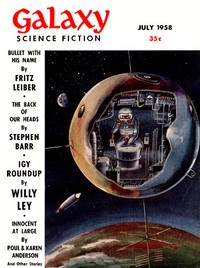
The Back of Our Heads
Written by Stephen Barr
Chaptra reads alongside you — AI insights, chapter breakdowns and reader discussions for every book. Join free
About this book
Reading guide
Themes, characters and key ideas in The Back of Our Heads, written by Chaptra AI.
- about 6 hours
- advanced
- philosophical
- introspective
- mysterious
Stephen Barr's "The Back of Our Heads" is a profound science fiction novella from the late 1950s that delves into the intricate nature of identity, existence, and consciousness. It follows a central female character, referred to as "she," who experiences an endless cycle of lives across vastly different timelines and forms, from primitive eras to contemporary settings. Through a series of introspective dialogues, the novella explores her accumulated wisdom and struggles with loss, transformation, and the enduring human quest for understanding. The narrative masterfully blends philosophical inquiry with comedic elements, offering a unique commentary on the human experience and the interconnectedness of all lives.
“Every ending was merely a new beginning, though the lessons often felt brand new, as if I'd never lived them before.”
Key themes
- Identity and Selfhood
- The novella profoundly questions the nature of identity when a consciousness experiences countless lives, forms, and genders. It explores whether identity is tied to memory, physicality, or a more elusive, enduring essence that transcends individual experiences. The protagonist's journey is a continuous quest to understand 'who she is' amidst constant transformation.
- The Nature of Consciousness and Existence
- Barr delves into the fundamental questions of what it means to exist, exploring consciousness not as a singular, finite entity, but as a potentially continuous, evolving phenomenon. The novella suggests that individual lives might be facets of a larger, collective consciousness, or that consciousness itself is a fundamental property of the universe, capable of inhabiting diverse forms.
- The Human Condition and Connection Across Time
- Despite the vast differences in eras and forms, the novella highlights the enduring aspects of the human condition: love, loss, fear, joy, the search for meaning, and the need for connection. Through the protagonist's varied experiences, Barr illustrates how these fundamental elements bind humanity across all historical and cultural divides.
Worth discussing
How does the novella challenge conventional notions of identity and selfhood?
Chapter-by-chapter breakdowns, character arcs and the full thematic analysis come with a free account.
Discussions
No one has started one yet
Questions this book opens up
No discussions yet
Be the first to start a discussion about this book!
Sign up to start the discussionReviews
No reviews yet
Be the first to review this book!