
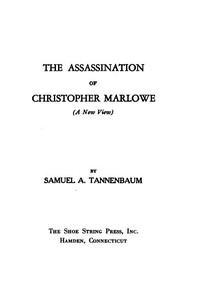
The Assassination of Christopher Marlowe (A New View)
Written by Samuel A. (Samuel Aaron) Tannenbaum
Chaptra reads alongside you — AI insights, chapter breakdowns and reader discussions for every book. Join free
About this book
Reading guide
Themes, characters and key ideas in The Assassination of Christopher Marlowe (A New View), written by Chaptra AI.
- about 8 hours
- advanced
- Mysterious
- Investigative
- Historical
Samuel A. Tannenbaum's "The Assassination of Christopher Marlowe (A New View)" is a seminal historical account from the late 1920s that re-examines the mysterious death of the Elizabethan playwright. Challenging the long-accepted narrative of a drunken brawl, Tannenbaum meticulously argues that Marlowe's demise on May 30, 1593, was a calculated political assassination. He delves into the complex web of Elizabethan court intrigue, positing that powerful figures, including Sir Walter Raleigh, orchestrated the murder to silence Marlowe, who allegedly possessed dangerous state secrets. The book investigates contemporary documents, including the coerced testimony of Thomas Kyd, to build a compelling case for a conspiracy driven by political machinations and the desire to suppress dissent in a tumultuous era.
“The accepted narrative of Marlowe’s death as a drunken brawl masks a far more sinister truth, carefully constructed to obscure the machinations of the Elizabethan court.”
Key themes
- Political Intrigue and Corruption
- This is the central theme, as Tannenbaum argues that Marlowe's death was a result of complex political machinations within the Elizabethan court. The book explores how powerful figures used their influence, espionage, and even murder to maintain control and silence threats to their authority or state secrets.
- Historical Revisionism and The Search for Truth
- Tannenbaum's entire premise is to challenge and revise a long-accepted historical narrative. The book exemplifies the process of historical revisionism, demonstrating how new interpretations of existing evidence, or the re-contextualization of events, can fundamentally alter our understanding of the past. It champions the ongoing scholarly pursuit of truth.
- The Power of State Secrets and Dissent
- The book argues that Marlowe's alleged possession of sensitive state secrets and his potentially dissenting views made him a target. This theme explores how knowledge can be dangerous, and how authoritarian regimes suppress individuals who pose intellectual or informational threats, often under the guise of heresy or sedition.
Worth discussing
How does Tannenbaum challenge traditional historical narratives surrounding Christopher Marlowe's death? What makes his 'new view' compelling or controversial?
Chapter-by-chapter breakdowns, character arcs and the full thematic analysis come with a free account.
Discussions
No one has started one yet
Questions this book opens up
No discussions yet
Be the first to start a discussion about this book!
Sign up to start the discussionReviews
No reviews yet
Be the first to review this book!