
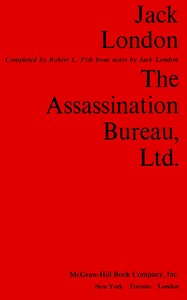
The Assassination Bureau, Ltd.
Written by Jack London,Robert L. Fish
Chaptra reads alongside you — AI insights, chapter breakdowns and reader discussions for every book. Join free
About this book
Reading guide
Themes, characters and key ideas in The Assassination Bureau, Ltd., written by Chaptra AI.
- about 8 hours
- intermediate
- philosophical
- adventurous
- tense
Jack London's posthumously completed novel, "The Assassination Bureau, Ltd.," finished by Robert L. Fish, plunges into a morally ambiguous world where a clandestine organization offers assassination services governed by a strict ethical code. Led by the enigmatic Ivan Dragomiloff, the Bureau aims to eliminate individuals deemed detrimental to society, challenging conventional notions of justice and vigilante action. The narrative propels into high gear when Dragomiloff, disillusioned with his own rigid system, orchestrates his own assassination, forcing his organization to hunt him across the globe. This transforms the philosophical premise into a thrilling chase, intertwining complex ethical debates with high-stakes adventure and a burgeoning romance.
“"We kill only those who deserve to die, those who are a cancer to humanity."”
Key themes
- Morality and Justice
- The central theme, explored through the Bureau's existence and Dragomiloff's personal quest. The novel challenges conventional definitions of justice, asking whether it can be served outside the confines of the law, and if taking a life can ever be an ethical act when aimed at a greater good. It delves into the inherent contradictions of a 'moral' assassination service.
- Anarchy vs. Order
- The novel explores the tension between individual freedom and societal control, and between a state-sanctioned justice system and a self-appointed one. Dragomiloff's Bureau represents a unique form of ordered anarchy, operating outside traditional laws but with its own internal regulations, contrasting with the pure, chaotic anarchy represented by figures like Hausmann.
- Identity and Purpose
- Dragomiloff's decision to become his own target is a profound exploration of identity and purpose. He questions the meaning of his life's work and seeks to test the very core of his being and the organization he created. This theme extends to Marcie, who must re-evaluate her own purpose as a journalist and her understanding of truth.
Worth discussing
Is it ever morally justifiable for a private organization to take the law into its own hands and execute individuals it deems 'evil'?
Chapter-by-chapter breakdowns, character arcs and the full thematic analysis come with a free account.
Discussions
No one has started one yet
Questions this book opens up
No discussions yet
Be the first to start a discussion about this book!
Sign up to start the discussionReviews
No reviews yet
Be the first to review this book!