
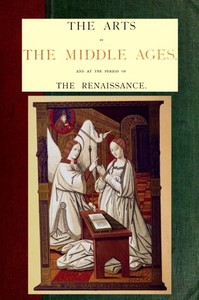
The Arts in the Middle Ages and at the Period of the Renaissance
Written by P. L. Jacob
Chaptra reads alongside you — AI insights, chapter breakdowns and reader discussions for every book. Join free
About this book
Read it with a club
Small groups reading the same books and talking as they go.


News
- 4 members
- 1,813 discussions
- Active Sep 11
Read The Arts in the Middle Ages and at the Period of the Renaissance alongside people who are reading it too.
Also here: News Bulletin, Just Joking....
Chaptra Prime — paid clubs, every club feature, and unlimited reading support, for $5 a month or $60 once.
See PrimeReading guide
Themes, characters and key ideas in The Arts in the Middle Ages and at the Period of the Renaissance, written by Chaptra AI.
- about 18 hours
- advanced
- Informative
- Historical
- Scholarly
P. L. Jacob's (Paul Lacroix) "The Arts in the Middle Ages and at the Period of the Renaissance" is a comprehensive 19th-century historical account detailing the evolution of European art. The work meticulously traces the transition from the Middle Ages' spiritual and often rugged aesthetic to the Renaissance's flourishing creativity, characterized by classical ideals of beauty and form. Lacroix explores various art forms, from architecture to decorative arts, emphasizing their intricate craftsmanship and profound cultural impacts. The book fundamentally argues that art serves as a direct reflection of historical development, societal changes, and the progression from simpler times to periods of cultural richness and prosperity.
“Our ambitious project focuses on the transition of art from the Middle Ages—characterized by a spiritual and often rugged aesthetic—to the flourishing creativity of the Renaissance, which embraced classical ideals of beauty and form.”
Key themes
- Evolution of Art and Aesthetics
- This theme explores the foundational shift in artistic principles and visual language from the Middle Ages to the Renaissance. Lacroix details how art moved from a focus on spiritual symbolism, often expressed through rugged or stylized forms, to an embrace of classical antiquity's emphasis on humanism, anatomical accuracy, perspective, and idealized beauty. This evolution encompasses changes in subject matter, technique, and the very purpose of art, illustrating a profound transformation in aesthetic values.
- Art as a Reflection of Society and History
- Lacroix posits that artistic expressions are not isolated phenomena but direct mirrors of the historical, social, economic, and cultural conditions of their time. He illustrates how societal developments—such as the move from a more rudimentary, 'barbaric' state to one of 'prosperity and cultural richness'—directly manifest in the complexity, ornamentation, and thematic content of art. Art, in this view, becomes a historical document, revealing values, technologies, and power structures of its epoch.
- Craftsmanship and Material Culture
- This theme emphasizes the practical aspects of art production, focusing on the materials, techniques, and skill involved in creating artifacts. Lacroix's detailed discussion of furniture and decorative arts highlights the importance of the artisan and the evolution of craftsmanship. It demonstrates how technological advancements, access to new materials, and increasing demand for luxury goods drove innovation in artistic production, transforming simple utilitarian objects into highly ornate works of art.
Worth discussing
How does Lacroix's 19th-century perspective shape his interpretation of medieval and Renaissance art? What biases might be present in his analysis?
Chapter-by-chapter breakdowns, character arcs and the full thematic analysis come with a free account.
Discussions
No one has started one yet
Questions this book opens up
No discussions yet
Be the first to start a discussion about this book!
Sign up to start the discussionReviews
No reviews yet
Be the first to review this book!