
About this book
Reading guide
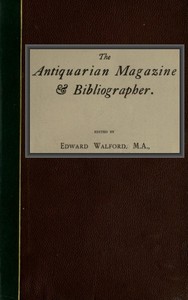
Themes, characters and key ideas in The Antiquarian Magazine & Bibliographer; Vol. 4, July-Dec 1884, written by Chaptra AI.
- about 8 hours
- advanced
- Informative
- Scholarly
- Historical
Volume 4 (July-Dec 1884) of "The Antiquarian Magazine & Bibliographer" by Various is a late 19th-century scholarly journal dedicated to the study and preservation of England's historical, archaeological, and bibliographical heritage. It compiles a diverse range of articles, delving into local histories, notable architectural structures, and significant historical figures and events. The volume commences with an in-depth exploration of the Great Yarmouth Tolhouse, meticulously detailing its evolution from a civic building to a prison, and its architectural and socio-historical significance. This collection collectively underscores the Victorian era's burgeoning interest in antiquarianism, emphasizing the importance of historical documentation, architectural preservation, and the continuous re-evaluation of national identity through its past.
“The Great Yarmouth Tolhouse stands as a venerable monument, its stones echoing centuries of civic life and municipal justice, a testament to England's intricate legal and social evolution.”
Key themes
- Preservation of History
- This theme is central to the entire volume, manifesting in the detailed documentation of historical sites, figures, and texts. The articles meticulously describe architectural features, historical functions, and the significance of various relics, implicitly and explicitly arguing for their preservation. The Great Yarmouth Tolhouse serves as a prime example, its multifaceted history being carefully chronicled to ensure its legacy endures. The collective effort of the 'Various' authors is a testament to the era's dedication to safeguarding England's tangible and intangible heritage for future generations.
- Local Identity and Regional History
- The journal frequently delves into the specific histories of English towns and regions, highlighting how local narratives contribute to the broader national story. By focusing on particular places like Great Yarmouth, the volume explores the unique socio-economic, political, and cultural developments that shaped distinct communities. This emphasis on the particular over the general underscores the belief that national identity is a mosaic formed from countless regional histories, each with its own specific characters, events, and architectural heritage. It reflects a desire to understand England from the ground up, recognizing the rich diversity within its borders.
- Scholarship and Research Methodologies
- The volume itself is a product and demonstration of late 19th-century historical and bibliographical scholarship. The articles showcase the meticulous research methods employed, including the reliance on primary sources, architectural analysis, genealogical studies, and critical interpretation of historical texts. It highlights the intellectual rigor and dedication required for antiquarian pursuits, emphasizing accuracy, evidence-based arguments, and thorough documentation. The 'Various' authors collectively represent a community of scholars engaged in the systematic pursuit of historical truth, setting standards for academic inquiry in their field.
Worth discussing
How does the focus on specific local sites, like the Great Yarmouth Tolhouse, contribute to a broader understanding of national history?
Chapter-by-chapter breakdowns, character arcs and the full thematic analysis come with a free account.
Discussions
No one has started one yet
Questions this book opens up
No discussions yet
Be the first to start a discussion about this book!
Sign up to start the discussionReviews
No reviews yet
Be the first to review this book!