
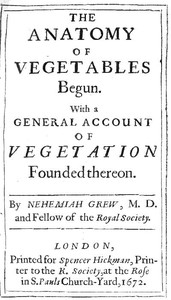
The Anatomy of Vegetables Begun: With a General Account of Vegetation founded thereon
Written by Nehemiah Grew
Chaptra reads alongside you — AI insights, chapter breakdowns and reader discussions for every book. Join free
About this book
Reading guide
Themes, characters and key ideas in The Anatomy of Vegetables Begun: With a General Account of Vegetation founded thereon, written by Chaptra AI.
- about 12 hours
- advanced
- Informative
- Analytical
- Systematic
Nehemiah Grew's "The Anatomy of Vegetables Begun" is a seminal 17th-century scientific treatise that laid foundational groundwork for plant anatomy and physiology. Grew meticulously documents his observations and dissections of various plant parts, particularly focusing on the garden bean, to understand the process of vegetation from seed to mature plant. The work emphasizes the critical role of empirical observation and systematic study, highlighting a significant gap in botanical knowledge compared to animal anatomy at the time. Through detailed analysis of structures like the seed's coats, radicle, and plume, Grew sought to uncover the underlying principles governing plant growth and life. This publication marks a pivotal moment in the history of botany, promoting a rigorous, anatomical approach to understanding the natural world.
“It is with no small wonder that we observe the intricate engine of vegetation, an engine heretofore but cursorily examined, whose true anatomy promises revelations far surpassing mere conjecture.”
Key themes
- The Importance of Empirical Observation and Dissection
- This is the central methodological theme of Grew's work. He argues passionately for the necessity of direct, hands-on observation and detailed anatomical dissection as the only reliable path to understanding plant life. This contrasts with earlier, more speculative approaches and aligns with the burgeoning empirical spirit of the Scientific Revolution. Grew’s entire treatise is a demonstration of this principle in practice.
- The Structure-Function Relationship in Biology
- Grew consistently seeks to understand the purpose or 'office' of each plant part by examining its physical structure. He doesn't just describe what he sees but attempts to explain *why* it is shaped that way and *what* role it plays in the plant's life cycle. This establishes a fundamental principle of biology: that form follows function, and understanding one illuminates the other.
- Pioneering Scientific Inquiry and the Unexplored Natural World
- Grew's treatise embodies the spirit of exploration and discovery prevalent in the 17th century. He highlights the vastness of the unknown in the natural world, particularly concerning plants, and positions his work as a crucial first step into this unexplored territory. It's a call to arms for scientific investigation, demonstrating the value of delving into subjects previously deemed too mundane or complex.
Worth discussing
How did Grew's methodological approach in 'The Anatomy of Vegetables Begun' contribute to the Scientific Revolution?
Chapter-by-chapter breakdowns, character arcs and the full thematic analysis come with a free account.
Discussions
No one has started one yet
Questions this book opens up
No discussions yet
Be the first to start a discussion about this book!
Sign up to start the discussionReviews
No reviews yet
Be the first to review this book!