
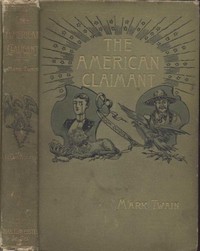
The American Claimant
Written by Mark Twain
Chaptra reads alongside you — AI insights, chapter breakdowns and reader discussions for every book. Join free
About this book
Reading guide
Themes, characters and key ideas in The American Claimant, written by Chaptra AI.
- about 8 hours
- intermediate
- humorous
- satirical
- farcical
Mark Twain's "The American Claimant" is a satirical novel that intertwines the convoluted tale of an English lord seeking to renounce his title and embrace American democracy with the fantastic schemes of Colonel Sellers, a perpetually optimistic but perpetually broke American inventor. Lord Berkeley, believing himself cursed and seeking a simpler life, swaps identities with a commoner and travels to America, only to encounter the eccentric Sellers, who has himself inherited a dormant claim to the English earldom. The narrative playfully explores themes of identity, social class, American democratic ideals versus European aristocracy, and the enduring human capacity for delusion and reinvention. Through a series of farcical events and mistaken identities, Twain critiques both the allure of inherited status and the often-absurd realities of chasing the American dream.
“I've got a scheme that'll make us all millionaires!”
Key themes
- American vs. European Aristocracy/Democracy
- The central theme of the novel, exploring the inherent conflict and contrast between the inherited status and tradition of European aristocracy and the self-made, democratic ideals of America. Twain uses Lord Berkeley's desire to escape his title and Colonel Sellers's desperate yearning for one to satirize both systems. He questions whether American democracy truly offers freedom from class distinctions or if Americans merely replace old aristocracies with new forms of social hierarchy based on wealth.
- The Power of Imagination and Delusion
- This theme is almost entirely embodied by Colonel Sellers, whose boundless optimism and belief in his fantastic inventions and schemes border on delusion. Twain explores how imagination can be a source of hope and resilience, but also a barrier to reality, leading to perpetual unfulfilled expectations. Sellers's ability to live richly in his mind, despite his poverty, is both humorous and poignant, highlighting the human need for dreams.
- Identity and Reinvention
- The novel is replete with characters changing or attempting to change their identities. Lord Berkeley sheds his aristocratic persona to become a commoner, while Colonel Sellers tries to claim a noble identity. This theme explores the fluidity of self, the performance of identity, and whether one's true nature is defined by birth, status, or personal actions. Twain questions whether people can truly escape their past or fully embody a new persona.
Worth discussing
How does Twain use the characters of Lord Berkeley and Colonel Sellers to critique both European aristocracy and American democratic ideals?
Chapter-by-chapter breakdowns, character arcs and the full thematic analysis come with a free account.
Discussions
No one has started one yet
Questions this book opens up
No discussions yet
Be the first to start a discussion about this book!
Sign up to start the discussionReviews
No reviews yet
Be the first to review this book!