
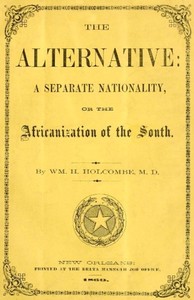
The Alternative: A Separate Nationality; or, The Africanization of the South
Written by William H. (William Henry) Holcombe
Chaptra reads alongside you — AI insights, chapter breakdowns and reader discussions for every book. Join free
About this book
Reading guide
Themes, characters and key ideas in The Alternative: A Separate Nationality; or, The Africanization of the South, written by Chaptra AI.
- about 8 hours
- advanced
- polemical
- urgent
- dogmatic
William H. Holcombe's "The Alternative: A Separate Nationality; or, The Africanization of the South" is a fervent pro-slavery treatise published in the early 1860s, arguing for the institution's necessity for the economic stability and cultural identity of the American South. Holcombe frames the conflict with Northern abolitionism as an existential threat, asserting that the South must either establish itself as a separate nation or face social and economic collapse, leading to a feared 'Africanization' of its society. He attempts to justify slavery on both economic and moral grounds, positing it as beneficial for enslaved African people and essential for white Southern civilization. The work serves as a powerful, albeit deeply prejudiced, articulation of Southern secessionist ideology just prior to and during the American Civil War, emphasizing racial hierarchy and cultural divergence as natural justifications for division.
“The South must either establish a separate nation or face destruction.”
Key themes
- Defense of Slavery
- This is the central theme of the book, where Holcombe attempts to justify the institution of slavery on economic, social, and moral grounds. He argues that slavery is essential for the South's prosperity, provides a stable social order, and even 'uplifts' African people by exposing them to Christianity and civilization (a deeply racist and paternalistic view).
- Racial Hierarchy and White Supremacy
- Underlying all of Holcombe's arguments is the deeply ingrained belief in a racial hierarchy, with white people at the top and African people as inherently inferior, destined for servitude. This theme is the bedrock upon which his defense of slavery and his fear of 'Africanization' are built, justifying the subjugation of one race by another.
- Southern Nationalism and Secession
- Holcombe advocates for the formation of a separate Southern nation, arguing that the cultural, economic, and racial differences between the North and South are irreconcilable. He calls for Southern unity in the face of perceived Northern aggression and abolitionist threats, presenting secession as the only path to preserve Southern identity and institutions.
Worth discussing
How does Holcombe attempt to morally justify slavery, and what are the inherent flaws in his arguments?
Chapter-by-chapter breakdowns, character arcs and the full thematic analysis come with a free account.
Discussions
No one has started one yet
Questions this book opens up
No discussions yet
Be the first to start a discussion about this book!
Sign up to start the discussionReviews
No reviews yet
Be the first to review this book!