
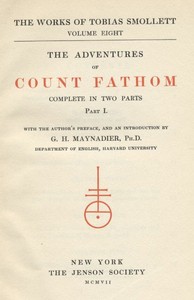
The Adventures of Ferdinand Count Fathom — Complete
Written by T. (Tobias) Smollett
Chaptra reads alongside you — AI insights, chapter breakdowns and reader discussions for every book. Join free
About this book
Read it with a club
Chaptra's fiction clubs — small groups reading the same books and talking as they go.


CraxMe Readers Book Club
Fiction
- 385 members
- 227 discussions
- Started December 2025
Welcome to the Readers Book Club. This is an informal group for like-minded people, where you can discuss books, share and recommend, track your reading progress, and lots more. Discuss Books — all about books. Discuss a particular book or genre, share your favourite quotes. Book Reviews — loved a book and highly recommend it? Or was it just average? Share your review and discuss with fellow readers. (May contain spoilers.) Group Reads — what is a book club without a group read! Buddy Reads — planning to read a book and looking for someone to read it with? Post in the Buddy Read request thread, find a reading buddy, and start discussing.
Read The Adventures of Ferdinand Count Fathom — Complete alongside people who are reading it too.
Also here: Doorstops, First Lines Club
Chaptra Prime — paid clubs, every club feature, and unlimited reading support, for $5 a month or $60 once.
See PrimeReading guide
Themes, characters and key ideas in The Adventures of Ferdinand Count Fathom — Complete, written by Chaptra AI.
- about 15 hours
- advanced
- dark
- satirical
- cynical
Tobias Smollett's 'The Adventures of Ferdinand Count Fathom' is a picaresque yet darkly satirical novel chronicling the life of its eponymous anti-hero, a master of deception and manipulation. Born to a camp follower, Fathom rises through society by exploiting the gullibility and vices of others, driven by avarice and a profound lack of empathy. The narrative follows his elaborate schemes to defraud, seduce, and betray, showcasing the moral decay beneath the veneer of polite society. Ultimately, the novel explores themes of vice and virtue, portraying Fathom's eventual downfall and a somewhat forced redemption, serving as a cautionary tale against unchecked ambition and depravity.
“"The human heart, when it is once infected with the poison of corruption, becomes a fountain of iniquity, which sends forth streams of vice, that desolate every field of virtue."”
Key themes
- Vice and Virtue
- This is the central theme, explicitly explored through the stark contrast between Fathom's unbridled depravity and the suffering virtue of characters like Monimia and Renaldo. Smollett uses Fathom's journey to investigate the nature of evil, questioning whether it is innate or cultivated, and to demonstrate the vulnerability of goodness in a corrupt world. The novel's moralizing tone often emphasizes the eventual triumph of virtue, albeit sometimes through external intervention.
- Deception and Manipulation
- Fathom's character is defined by his mastery of deception. The novel meticulously details his elaborate cons, use of false identities, and psychological manipulation of others. This theme highlights the ease with which appearances can mislead and the gullibility of those who fall prey to Fathom's charms, serving as a critique of social superficiality and the dangers of misplaced trust.
- Social Hypocrisy and Satire
- Smollett uses Fathom's exploits as a vehicle for biting satire of 18th-century European society. He exposes the superficiality, vanity, and moral decay hidden beneath the polished veneer of aristocracy, the venality of the legal system, and the corruption of human nature across different social strata. The novel critiques a society that values appearance over substance, making it ripe for Fathom's exploitation.
Worth discussing
How does Smollett's portrayal of Fathom challenge or conform to the picaresque tradition? What makes Fathom a distinct anti-hero?
Chapter-by-chapter breakdowns, character arcs and the full thematic analysis come with a free account.
Discussions
No one has started one yet
Questions this book opens up
No discussions yet
Be the first to start a discussion about this book!
Sign up to start the discussionReviews
No reviews yet
Be the first to review this book!