
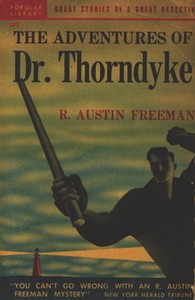
The adventures of Dr. Thorndyke (The singing bone)
Written by R. Austin (Richard Austin) Freeman
Chaptra reads alongside you — AI insights, chapter breakdowns and reader discussions for every book. Join free
About this book
Reading guide
Themes, characters and key ideas in The adventures of Dr. Thorndyke (The singing bone), written by Chaptra AI.
- about 10 hours
- intermediate
- analytical
- mysterious
- intellectual
R. Austin Freeman's "The Adventures of Dr. Thorndyke," often highlighted by the groundbreaking novella "The Singing Bone" (also known as "The Case of Oscar Brodski"), introduces Dr. John Thorndyke, a pioneering forensic scientist and detective. This collection of stories showcases Thorndyke's meticulous application of scientific principles, from toxicology to physical anthropology, to unravel complex criminal cases. Unlike his contemporaries who relied heavily on deduction from observable facts, Thorndyke's method is rooted in empirical evidence and experimental verification, making him a progenitor of modern forensic fiction. The narratives are characterized by intricate plots, intellectual challenges, and a deliberate pace that emphasizes the process of scientific investigation over dramatic action. The book effectively establishes Thorndyke as a unique and influential figure in the evolution of the detective genre.
“"It is always the insignificant detail, the overlooked trifle, that holds the key to the most baffling mysteries."”
Key themes
- The Primacy of Scientific Evidence
- This is the central theme, emphasizing that objective, verifiable scientific data is the only reliable path to truth and justice. Freeman meticulously details Thorndyke's use of forensic techniques—microscopy, chemical analysis, anatomical study, and experimental reconstruction—to solve crimes, often discrediting subjective human testimony or circumstantial evidence.
- The Fallibility of Human Perception and Testimony
- The stories frequently highlight how easily human witnesses can be mistaken, misled, or outright deceived. Thorndyke often has to cut through layers of misinterpretation, faulty memory, or deliberate lies to get to the objective truth, demonstrating that what appears obvious to the layperson can be profoundly wrong.
- Innovation and Progress in Investigation
- The book itself is a testament to the idea of progress, specifically in the field of criminal investigation. Thorndyke represents the cutting edge of forensic science in his era, constantly pushing the boundaries of what is possible in crime-solving. The stories implicitly argue for the adoption of scientific methods over traditional, less precise police work.
Worth discussing
How does Dr. Thorndyke's scientific approach differ from other famous detectives like Sherlock Holmes or Hercule Poirot? What are the advantages and disadvantages of each?
Chapter-by-chapter breakdowns, character arcs and the full thematic analysis come with a free account.
Discussions
No one has started one yet
Questions this book opens up
No discussions yet
Be the first to start a discussion about this book!
Sign up to start the discussionReviews
No reviews yet
Be the first to review this book!