
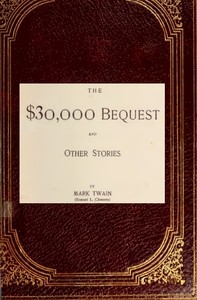
The $30,000 Bequest, and Other Stories
Written by Mark Twain
Chaptra reads alongside you — AI insights, chapter breakdowns and reader discussions for every book. Join free
About this book
Reading guide
Themes, characters and key ideas in The $30,000 Bequest, and Other Stories, written by Chaptra AI.
- about 8 hours
- intermediate
- humorous
- satirical
- witty
Mark Twain's "The $30,000 Bequest, and Other Stories" is a collection of late 19th-century humorous short stories, primarily showcasing his sharp social commentary and satirical wit. The titular opening story introduces the modest Fosters, Saladin and Electra, whose lives are upended by the fantastical promise of a $30,000 inheritance from a reclusive relative. This narrative deftly explores the corrupting influence of imagined wealth, revealing how dreams of fortune can distort behavior and relationships, leading characters into absurd plans and a detachment from reality. Through the Fosters' descent into materialistic fantasy, Twain critiques American aspirations and the often-ludicrous human response to the prospect of easy money. The collection as a whole offers a diverse array of Twain's characteristic humor, irony, and keen observations on human nature and societal follies.
“"It is by the grace of God that in our country we have three unspeakably precious things: freedom of speech, freedom of conscience, and the prudence never to practice either of them."”
Key themes
- The Illusion of Wealth and Materialism
- This theme explores how the *promise* or *idea* of wealth can be as powerful, and potentially destructive, as actual riches. Twain demonstrates that an obsession with material gain can lead to delusion, alter one's perception of reality, and erode contentment, even before any money is acquired. The Fosters' elaborate planning for their phantom fortune illustrates the emptiness of material aspirations when pursued for their own sake.
- Human Greed and Aspiration
- Twain delves into the inherent human tendency towards greed and the boundless nature of aspiration. Once the Fosters believe wealth is within reach, their desires escalate exponentially, revealing a bottomless pit of wants. This theme questions whether there's a limit to human desire once the floodgates of possibility are opened, and how quickly 'enough' becomes 'more'.
- Social Satire and Critique of American Society
- Twain uses the Fosters' story as a vehicle to satirize aspects of American society during the Gilded Age, particularly its burgeoning materialism and the often-hypocritical pursuit of social status through wealth. He critiques the superficiality of aspirations driven by money rather than genuine fulfillment, highlighting the absurdity of a society that values perceived fortune over actual contentment and character.
Worth discussing
How does the Fosters' behavior change once they conceive of the inheritance, and what does this reveal about human nature?
Chapter-by-chapter breakdowns, character arcs and the full thematic analysis come with a free account.
Discussions
No one has started one yet
Questions this book opens up
No discussions yet
Be the first to start a discussion about this book!
Sign up to start the discussionReviews
No reviews yet
Be the first to review this book!