
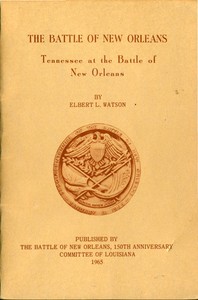
Tennessee at the Battle of New Orleans
Written by Elbert L. Watson
Chaptra reads alongside you — AI insights, chapter breakdowns and reader discussions for every book. Join free
About this book
Reading guide
Themes, characters and key ideas in Tennessee at the Battle of New Orleans, written by Chaptra AI.
- about 8 hours
- intermediate
- informative
- historical
- patriotic
Elbert L. Watson's "Tennessee at the Battle of New Orleans" is a mid-20th-century historical account, published in the 1960s, that meticulously details the crucial involvement of Tennessee troops in the Battle of New Orleans during the War of 1812. The book chronicles the escalating tensions between the United States and Great Britain, culminating in the British invasion, and provides an in-depth analysis of the military strategies employed by both sides. Watson highlights the remarkable endurance, skill, and leadership demonstrated by the Tennessee militia under General Andrew Jackson and his subordinates, Generals Coffee and Carroll, against a superior British force. Ultimately, the narrative underscores Tennessee's indispensable contributions to this decisive victory, exploring its profound implications for American national unity and identity.
“"The defense of New Orleans was not merely a battle; it was a testament to the nascent American spirit, forged in the crucible of regional pride and unified purpose."”
Key themes
- Military Leadership and Strategy
- Watson provides a detailed analysis of the strategic and tactical decisions made by both sides, particularly highlighting Andrew Jackson's genius. The theme examines how effective leadership, innovative defensive strategies, and an understanding of terrain can overcome numerical and training disadvantages.
- National Identity and Unity
- The book explores how the Battle of New Orleans served as a powerful crucible for forging a nascent American national identity. It emphasizes how diverse groups—Tennessee frontiersmen, Louisiana Creoles, free men of color, and others—united under a common cause, transcending regional differences to defend the young nation's sovereignty and define its character.
- Regional Pride and Contribution
- The book explicitly champions the vital role played by Tennessee troops, particularly the militia under Coffee and Carroll. This theme explores how the specific contributions of a region or state can be central to a national effort, fostering a deep sense of local pride that feeds into the larger national narrative.
Worth discussing
How does Watson's focus on Tennessee troops alter or enhance your understanding of the Battle of New Orleans compared to broader historical accounts?
Chapter-by-chapter breakdowns, character arcs and the full thematic analysis come with a free account.
Discussions
No one has started one yet
Questions this book opens up
No discussions yet
Be the first to start a discussion about this book!
Sign up to start the discussionReviews
No reviews yet
Be the first to review this book!