
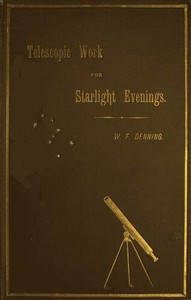
Telescopic Work for Starlight Evenings
Written by William F. (William Frederick) Denning
Chaptra reads alongside you — AI insights, chapter breakdowns and reader discussions for every book. Join free
About this book
Reading guide
Themes, characters and key ideas in Telescopic Work for Starlight Evenings, written by Chaptra AI.
- about 12 hours
- intermediate
- Educational
- Inspirational
- Informative
William F. Denning's "Telescopic Work for Starlight Evenings" is a late 19th-century scientific treatise designed to democratize astronomical observation. It meticulously examines telescopes and practical observing methods, bridging the gap between novice stargazers and advanced astrophysical concepts. The work integrates a rich historical context, tracing the evolution of telescopic technology and observation from Galileo's era, with revised articles and new content aimed at a general readership. Denning fosters enthusiasm for celestial inquiry, inviting readers to engage with the wonders of the night sky through accessible scientific explanation. The book serves as both an educational guide and an inspirational call to explore the cosmos.
“"The heavens, ever a source of wonder, reveal their profound secrets to the patient observer armed with the humblest of instruments."”
Key themes
- Accessibility of Science
- A core theme is Denning's commitment to making the complex field of astronomy accessible to a general readership, particularly amateur astronomers. He aims to demystify telescopic work and observation, providing practical guidance and clear explanations. This bridges the gap between specialized scientific knowledge and public engagement, fostering a broader appreciation for scientific inquiry.
- Scientific Progress and History
- Denning deeply explores the historical evolution of telescopic technology and observational techniques. By tracing advancements from the 17th century to his own time, he highlights the incremental nature of scientific discovery and the profound impact of key innovations and figures. This historical lens emphasizes that scientific understanding is a continuous, evolving process built upon past achievements.
- The Role of the Amateur Astronomer
- Denning champions the contribution and potential of the amateur astronomer. By providing practical methods and encouraging general readers, he elevates the role of non-professional observers in contributing to scientific knowledge and fostering a wider scientific community. This highlights the value of citizen science and individual curiosity in advancing human understanding.
Worth discussing
How does Denning's approach to popularizing science compare to modern science communication?
Chapter-by-chapter breakdowns, character arcs and the full thematic analysis come with a free account.
Discussions
No one has started one yet
Questions this book opens up
No discussions yet
Be the first to start a discussion about this book!
Sign up to start the discussionReviews
No reviews yet
Be the first to review this book!